
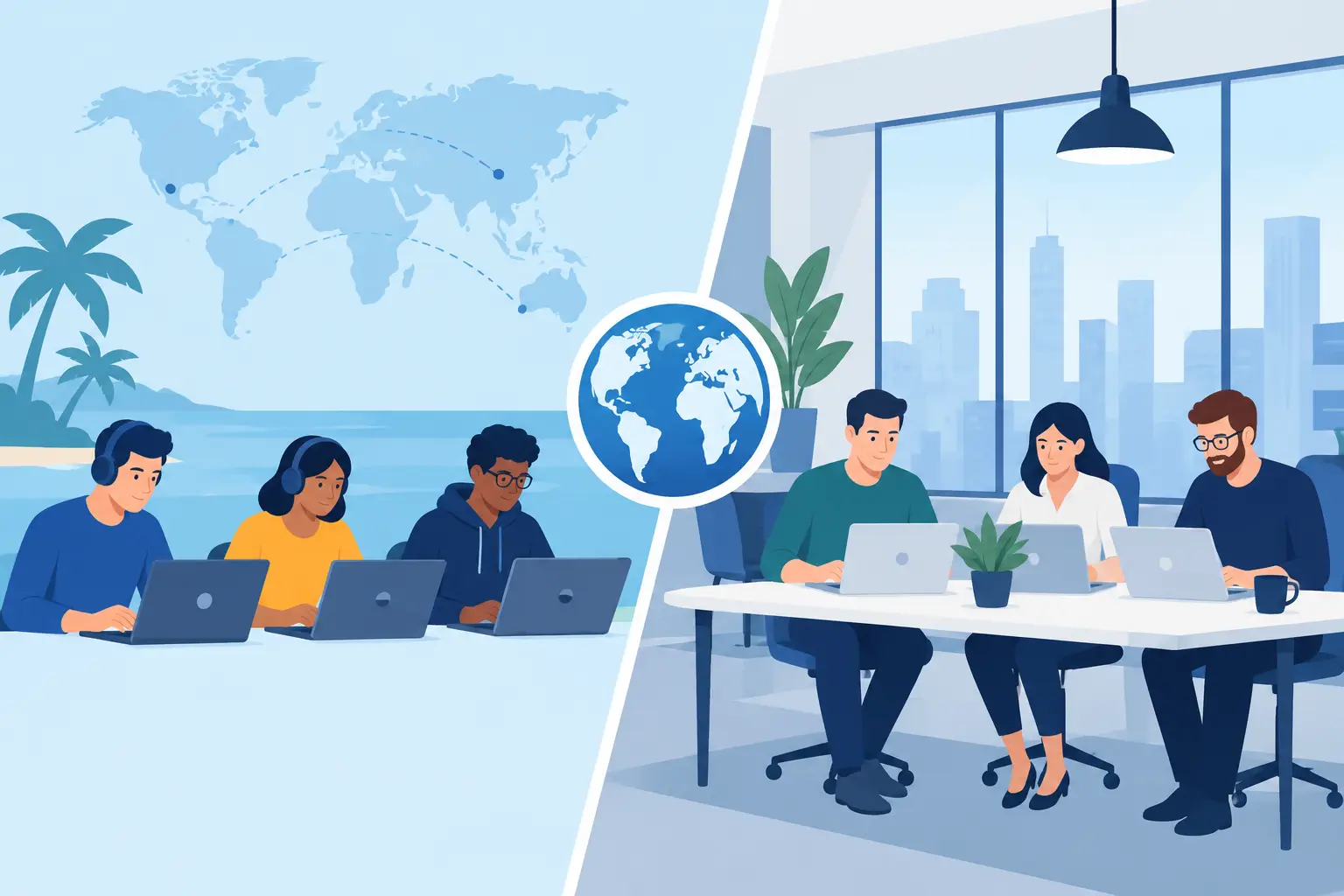
A delayed product launch rarely comes down to code alone. It comes down to whether the people building the product understand the business decision behind every feature, can resolve issues quickly, and remain accountable after release. The offshore versus inhouse developers decision affects all three – along with budget, speed, security, and your ability to scale.
For founders, operations leaders, and growing businesses, this is not simply a hiring choice. It is a delivery-model decision. The right answer depends on what you are building, how quickly it must reach the market, how much technical leadership you have internally, and whether the product will require ongoing evolution.
Offshore Versus Inhouse Developers: The Core Difference
An in-house development team works within your organization. You recruit, employ, manage, and retain engineers as part of your internal operation. They are immersed in your company goals, product strategy, customer feedback, and daily priorities.
An offshore development team is based in another country and delivers work remotely. This can mean hiring individual contractors, working with a dedicated overseas team, or engaging a software development company that provides strategy, design, engineering, quality assurance, and support.
The comparison is often framed as cost versus control. That is too narrow. A lower hourly rate does not automatically produce a lower total cost, and physical proximity does not automatically produce better outcomes. Product success depends on planning, communication, architecture, testing, ownership, and the ability to make good decisions when requirements change.
When an In-House Team Makes Sense
In-house development is a strong model when software is central to your competitive advantage and you have enough consistent work to support a full team. It gives leadership direct access to engineers and makes real-time collaboration easier, especially when product decisions shift daily.
This approach also works well when your company has established product management, technical leadership, hiring capacity, and a clear engineering roadmap. A mature organization that needs to build proprietary systems over several years may benefit from retaining deep internal knowledge.
However, building an in-house team takes more than posting a job description. You need to recruit, evaluate technical skills, onboard employees, define delivery processes, maintain development environments, manage performance, and provide career growth. For a startup or midsize business, those responsibilities can pull leadership attention away from customers, revenue, and market validation.
The financial commitment is broader than salary. It includes benefits, payroll taxes, equipment, software licenses, training, management time, and the cost of hiring mistakes. If your roadmap is still uncertain, staffing a complete internal team too early can create fixed costs before product demand is proven.
Where Offshore Development Creates Value
Offshore development can give businesses access to specialized skills and larger delivery capacity without the time and cost of assembling every capability internally. A capable partner can bring UX/UI design, mobile development, full-stack engineering, cloud architecture, API integration, quality assurance, DevOps, and maintenance into one coordinated engagement.
That breadth matters when a project needs more than coding. A customer-facing app may require discovery workshops, user flows, secure authentication, payment integration, analytics, testing across devices, app store deployment, and a post-launch improvement plan. Coordinating separate freelancers for each role can introduce risk. A structured offshore partner can provide a single delivery framework and clear accountability.
Cost efficiency is a real benefit, but it should be evaluated through total project value. A lower-cost team that needs frequent rework, misses deadlines, or builds an inflexible codebase will be expensive in the long run. The strongest offshore relationships combine competitive pricing with experienced technical leadership, documented processes, transparent reporting, and disciplined quality control.
Time zone differences can also be useful when managed well. Your internal stakeholders can review progress at the end of their workday, while the development team begins the next implementation cycle. Without clear communication practices, though, the same difference can slow decisions and create avoidable assumptions.
The Trade-Offs That Matter Most
Cost and financial flexibility
In-house teams require a predictable, ongoing investment. That can be the right choice for a company with a stable pipeline of product work. Offshore teams are generally more flexible because capacity can align with a project phase, from a focused MVP build to long-term application support.
Still, do not select a partner based on rate alone. Ask how estimates are created, how changes are handled, what is included in testing, and who owns deployment and maintenance. Transparent scope management protects your budget better than an attractive quote with unclear assumptions.
Product knowledge and control
Internal employees naturally absorb company context through daily interaction. They hear sales objections, customer concerns, operational bottlenecks, and leadership priorities. That proximity can lead to stronger product judgment.
An external team can reach a similar level of understanding, but it requires intentional collaboration. Product documentation, recurring planning meetings, demos, decision logs, and access to the right stakeholders are essential. The partner should ask challenging questions, not wait passively for tickets.
Speed to market
If you need to launch quickly, an experienced offshore partner may move faster because the team, tools, and delivery process already exist. You avoid months of recruiting individual developers before work begins.
Speed only helps if the work is pointed in the right direction. Start with discovery, user priorities, technical architecture, and a realistic release plan. Building the wrong features quickly is not momentum.
Security and intellectual property
Security should be a requirement in either model. An in-house team is not automatically secure, and an offshore team is not automatically risky. What matters is whether access controls, secure development practices, source-code ownership, confidentiality agreements, infrastructure policies, and testing procedures are defined and enforced.
Before starting, establish who owns the code, cloud accounts, domains, data, documentation, and design files. Your business should retain clear ownership and maintain visibility into the systems that support its product.
Long-term maintenance
Applications are never truly finished at launch. Operating systems change, dependencies require updates, security vulnerabilities emerge, customers request improvements, and growth can expose performance limits.
An in-house team can maintain continuity when the company has the resources to support it. A long-term development partner can do the same when maintenance is built into the relationship rather than treated as an afterthought. The critical issue is accountability after deployment.
A Third Option: An Embedded Development Partner
Many businesses do not need to choose between a fully internal team and a disconnected offshore vendor. A more practical model is an embedded development partner that operates as an extension of your business.
In this approach, your leadership owns product direction, customer insight, and commercial priorities. The technology partner contributes architecture, delivery management, engineering capacity, quality assurance, and ongoing technical guidance. You gain access to a broader team without carrying the full overhead of building each role internally.
This is especially effective for companies that need fractional CTO support, an MVP to validate an idea, modernization of a legacy platform, AI-powered workflow automation, or a mobile app connected to existing business systems. The partnership should be close enough to support strategic decisions while remaining flexible enough to scale with your roadmap.
At SolidAppMaker, that means treating the project as a product lifecycle, not a one-time build. Discovery clarifies the business case. Architecture creates a secure foundation. Development, testing, deployment, and maintenance follow a structured process with regular client visibility at every stage.
How to Make the Right Choice
Start with your operating reality rather than a preference for one model. If you have a mature technical leader, a stable pipeline of complex work, and the budget to build an engineering organization, in-house hiring may strengthen your long-term advantage.
If you need specialized capabilities quickly, want to control fixed costs, or lack the internal structure to manage a full engineering department, an offshore or blended partner model may be the better fit. The right partner will make communication, quality standards, security, and ownership visible from the beginning.
Ask prospective teams how they handle unclear requirements, changing priorities, production incidents, and post-launch requests. Their answers will reveal more than a portfolio or hourly rate. Strong teams describe a process, explain trade-offs plainly, and take responsibility for the outcome.
The best development model is the one that gives your business the confidence to make progress without creating technical debt, communication gaps, or a product you cannot support. Choose a team that can build what you need now and help you make smarter technology decisions as your business grows.