
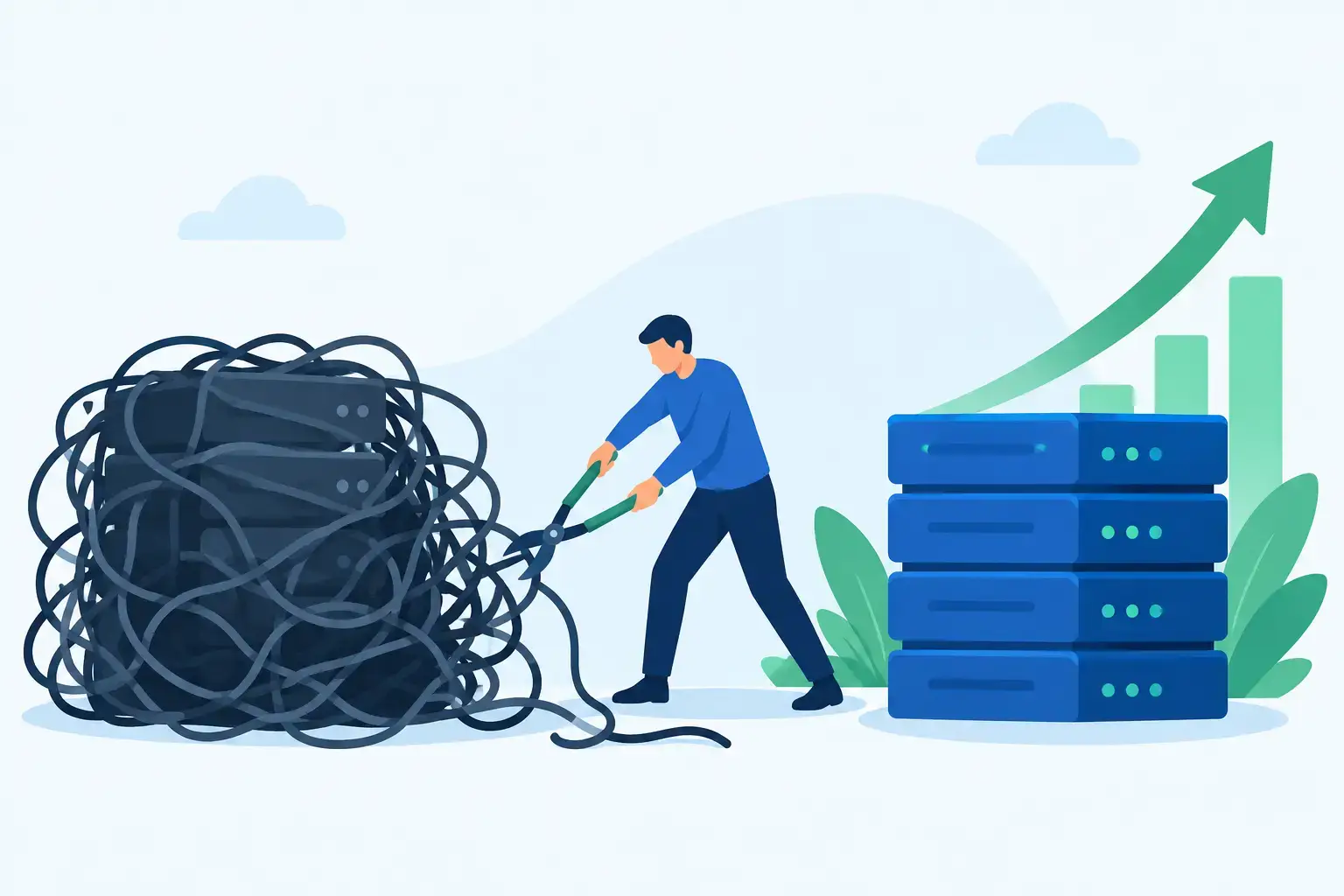
A critical release that takes three weeks instead of three days is rarely caused by one bad engineering decision. More often, it is the accumulated cost of shortcuts: an outdated integration nobody wants to touch, duplicated business rules, fragile deployment steps, or a database structure that no longer matches how the company operates. This guide to technical debt reduction helps business and product leaders turn that hidden drag into a manageable, measurable improvement plan.
Technical debt is not proof that a team has failed. Most growing businesses take on some debt deliberately to launch an MVP, meet a customer deadline, validate a new market, or replace a manual workflow quickly. The issue begins when those shortcuts remain invisible, unowned, and disconnected from business priorities.
Why Technical Debt Becomes a Growth Problem
Early in a product’s life, speed has a clear value. A startup may choose a simpler architecture to test demand before investing in a more advanced platform. An established company may add a temporary integration to keep an important customer account moving. These can be sound commercial decisions.
The problem is that temporary work often becomes permanent. As new features are layered onto weak foundations, delivery slows down. Engineers spend more time diagnosing regressions, security teams find more exceptions, and operations staff create manual workarounds because systems cannot reliably exchange data. Customers do not see a line item called technical debt, but they experience its effects through bugs, delayed improvements, inconsistent information, and unreliable service.
For leadership, the cost is also strategic. A team that cannot predict delivery dates has trouble planning campaigns, responding to market opportunities, or scaling a successful product. Reducing technical debt is therefore not simply an engineering cleanup exercise. It protects the organization’s ability to grow.
A Guide to Technical Debt Reduction: Start With Visibility
You cannot prioritize what has not been identified. The first step is to create a shared view of where debt exists and how it affects the business. This should not be a vague backlog labeled “cleanup.” Each item needs enough context for technical and nontechnical stakeholders to understand the risk.
A useful debt register records the affected system, the source of the problem, the likely consequence of leaving it in place, the teams or customers affected, and an initial estimate of effort. For example, “upgrade a deprecated payment API” is more useful when it also states that a vendor retirement date could interrupt checkout and affect monthly revenue.
Look beyond the codebase. Technical debt can exist in cloud infrastructure, third-party services, security permissions, data quality, mobile app dependencies, deployment scripts, documentation, and even unclear ownership. A beautiful application interface cannot compensate for an unreliable backend process or a manual spreadsheet acting as the real source of truth.
Discovery should combine automated assessment with team interviews. Code scanning, dependency reports, performance monitoring, error logs, and cloud cost analysis reveal measurable signals. Conversations with developers, support staff, sales teams, and operations leaders reveal the friction that dashboards may miss. If customer support repeatedly escalates a problem after a release, that pattern belongs in the assessment.
Prioritize Debt by Business Impact, Not Annoyance
Every engineering team has improvements it would like to make. Not every improvement deserves immediate investment. The strongest technical debt reduction plans rank work according to business exposure, not which issue is most frustrating to the person who found it.
Start with debt that creates a material security, compliance, revenue, or continuity risk. Unsupported libraries, weak access controls, unstable payment flows, and systems that threaten customer data should move quickly. Next, address debt that repeatedly slows high-value product work. If a fragile API makes every enterprise integration harder, improving that API may create more value than a series of isolated patches.
A practical decision framework considers five questions:
- What happens if this issue fails or remains unresolved?
- How likely is that outcome in the next six to twelve months?
- Which revenue, customer, security, or operational goal does it affect?
- Will resolving it make future product work faster or less risky?
- Is there a lower-risk interim fix while a larger modernization effort is planned?
This process also reveals when not to act immediately. A legacy internal tool with stable usage and no compliance exposure may be worth monitoring rather than rebuilding. Rewriting every older system is expensive and can create disruption without a proportional return. The right decision depends on the system’s business importance, change frequency, risk profile, and replacement cost.
Make Debt Reduction Part of Delivery
Technical debt programs fail when they are treated as work that happens only after all customer-facing priorities are complete. That moment rarely arrives. Instead, build debt reduction into the operating rhythm of product development.
For ongoing applications, reserve a consistent portion of development capacity for reliability, maintainability, and security work. The right allocation varies. A stable product may need a modest percentage, while a platform approaching a major scale event or compliance milestone may need a focused modernization phase. What matters is that the commitment is visible and protected, not quietly removed whenever a new request appears.
Tie debt work to planned initiatives where possible. If the business is launching a mobile app, improve the authentication service before expanding user access. If a new AI automation workflow depends on customer data, address duplicate records and unreliable integrations as part of that project. This approach keeps improvement work connected to outcomes leaders already value.
Teams should also define a clear “done” standard. A feature is not truly complete if it works only through a manual deployment, lacks meaningful monitoring, or introduces a known security exception with no owner. Better acceptance criteria prevent tomorrow’s debt while the team pays down yesterday’s.
Improve the Engineering System, Not Just Individual Tickets
A one-time remediation project can reduce the current backlog, but recurring debt usually points to a process problem. If rushed releases consistently create defects, the answer may be stronger automated testing, smaller release increments, clearer requirements, or more realistic planning. If integrations keep breaking, the organization may need API standards, versioning policies, and better observability.
Invest in architecture that allows change without forcing a full rebuild. Clear boundaries between services, documented data ownership, repeatable deployment pipelines, and automated regression testing reduce the cost of future decisions. These investments may not be visible to end users on release day, but they make future releases safer and more predictable.
Documentation deserves the same discipline. When key decisions exist only in one engineer’s memory, the business carries operational risk. Record system dependencies, deployment procedures, ownership responsibilities, and the rationale behind major architectural choices. Documentation does not need to be lengthy to be useful. It needs to be current enough that another capable team member can act with confidence.
Measure Progress in Business Terms
A shrinking backlog is useful, but it is not the whole story. Leaders should see whether debt reduction is improving delivery and reducing exposure. Track indicators such as release frequency, lead time for changes, production incidents, recovery time, failed deployment rates, cloud waste, support tickets, and security findings.
Pair those technical measures with business signals. Has the sales team gained confidence in launch dates? Are customers encountering fewer service interruptions? Can operations complete a workflow without manual reconciliation? Is the company able to onboard a new enterprise client without custom work every time?
Avoid using metrics as a way to pressure teams into superficial fixes. A lower count of tickets does not help if large risks are simply combined, renamed, or deferred. The goal is better system health and greater capacity for valuable work.
Create Clear Ownership Across the Business
Technical debt reduction requires executive support, but it should not depend on executives understanding every implementation detail. Leadership sets priorities, protects investment, and asks how technical risk affects growth. Product leaders connect the work to roadmap outcomes. Engineering leaders define the approach, estimates, quality standards, and operational safeguards.
For organizations without a full internal engineering department, a trusted technology partner can provide an outside assessment and a practical modernization roadmap. The most effective partnership does not begin with a predetermined rebuild. It begins by understanding the commercial goals, existing architecture, team capacity, and constraints. SolidAppMaker approaches this work as a long-term product and technology responsibility, balancing immediate business needs with the architecture required for sustainable growth.
Technical debt will never disappear completely, nor should that be the target. A healthy business makes conscious trade-offs, records them, and revisits them before they become expensive surprises. Start with the system that is slowing your next meaningful business move, give the work a clear owner, and turn each improvement into more room to build what comes next.