
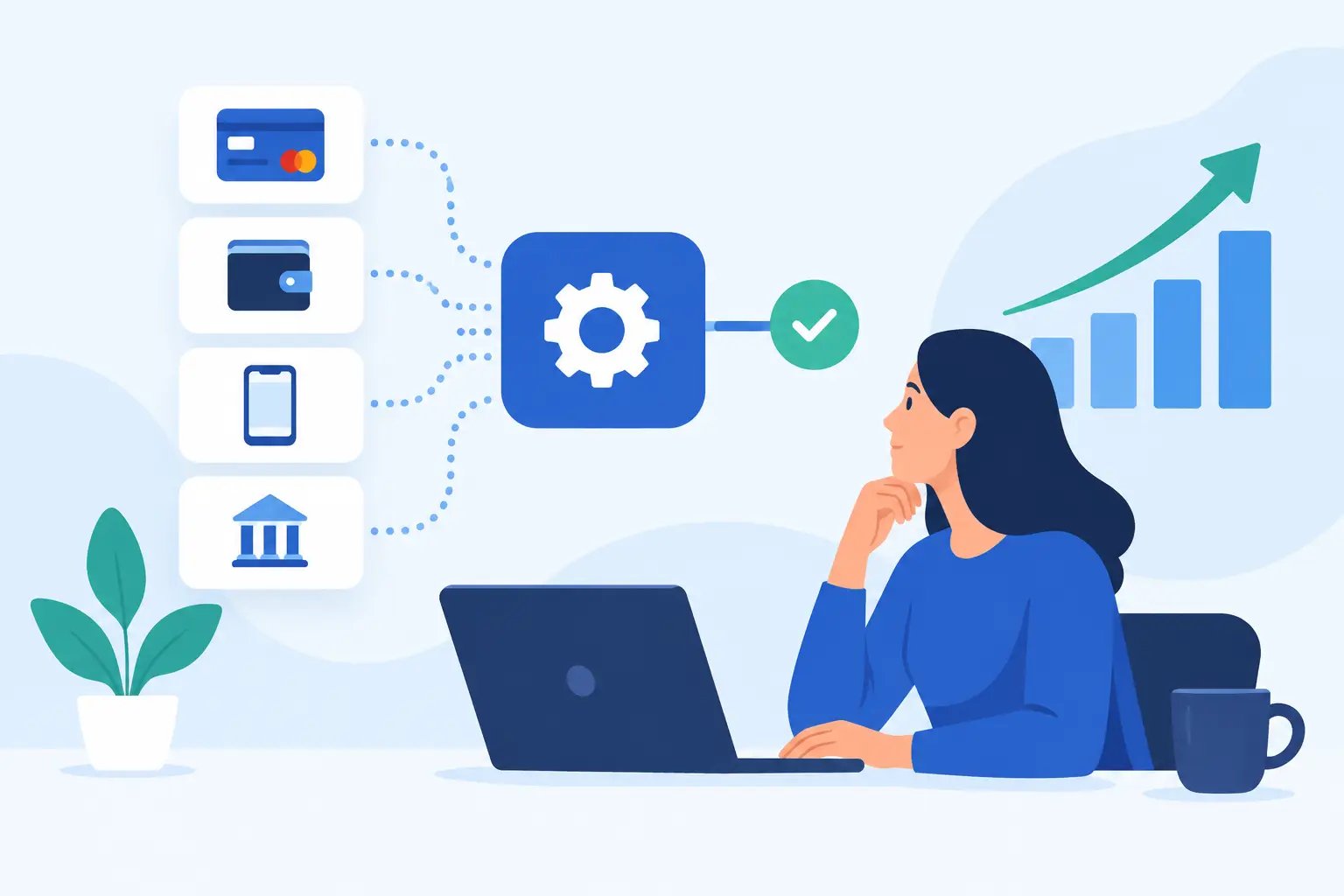
A payment failure is more than a lost transaction. It can mean an abandoned cart, a support ticket, a subscription cancellation, or a customer who never returns. For a startup or growing business, the payment layer directly affects revenue, customer trust, finance operations, and the speed at which your product can expand. This guide to choosing payment APIs helps business leaders evaluate providers as a long-term product decision, not a checkout feature added at the end of development.
The right API should support the way you sell today while giving your team room to introduce new products, markets, billing models, and customer experiences tomorrow. That requires looking beyond a provider’s basic ability to accept credit cards.
Start With Your Payment Model
Before comparing API documentation or transaction fees, define what customers are paying for and how they will pay. A one-time purchase, a recurring SaaS subscription, a marketplace payout, and an enterprise invoicing workflow have very different technical requirements.
For example, a direct-to-consumer ecommerce business may prioritize fast checkout, digital wallets, promotional codes, and fraud controls. A B2B software company may need recurring invoices, tax handling, usage-based billing, purchase-order workflows, and failed-payment recovery. A marketplace has another layer of complexity: it may need to onboard sellers, verify identities, split payments, hold funds, and manage payouts.
Write down the payment flows that are essential at launch, then identify the capabilities you expect to need in the next 12 to 24 months. This avoids selecting a simple payment API that works for an MVP but forces a costly migration once the business gains traction.
Evaluate the Integration Experience, Not Just the Feature List
Most payment providers can process cards. The difference often appears when your engineering team needs to customize the checkout flow, sync payment status with your CRM or ERP, handle edge cases, or troubleshoot a failed transaction.
A strong payment API should offer clear documentation, predictable API behavior, usable test environments, detailed error messages, and supported software development kits for your chosen technology stack. If you are building a mobile app, confirm that the provider supports secure native or cross-platform integrations for iPhone and Android. If you operate a web platform, review how the API works with your frontend framework, backend architecture, and hosting environment.
Also consider how much control you need over the customer experience. Hosted checkout pages can reduce development time and shift portions of compliance responsibility to the provider. They are often a smart choice for early-stage products or straightforward transactions. A custom payment form gives you greater control over branding and user flow, but it introduces more engineering work and potentially greater security responsibility.
There is no universal winner. The best approach depends on whether speed to market, conversion optimization, brand control, or specialized workflow requirements carry the most weight for your business.
Plan for Events and Exceptions
A payment is not complete simply because a customer presses a button. Cards are declined, banks require additional authentication, subscriptions renew unsuccessfully, refunds are requested, and disputes occur. Your application needs to react correctly when those events happen.
Review a provider’s webhook capabilities closely. Webhooks notify your systems when a payment succeeds, fails, is refunded, or changes status. They are essential for granting access to a subscription product, updating an order record, notifying operations teams, and reconciling revenue accurately.
Ask practical questions during evaluation: Can your team retry events safely? Are event logs available for troubleshooting? How are duplicate requests prevented? Can you test failure scenarios before launch? These details determine whether payment operations remain manageable as transaction volume increases.
Security and Compliance Must Fit Your Architecture
Payment data is highly sensitive, and security cannot be treated as a post-launch enhancement. At a minimum, your chosen provider should support industry-standard safeguards such as tokenization, encryption, fraud detection tools, strong customer authentication where required, and role-based access for your internal team.
PCI DSS compliance is central to card payment processing. The scope of your obligations depends on how payment details move through your application. A hosted checkout or provider-hosted payment field may significantly reduce the card data your systems handle. A fully custom card-entry experience can increase control, but it may also increase compliance complexity.
Security evaluation should also cover your own environment. Payment APIs must be implemented with protected API keys, restricted permissions, secure server-side processing, audit logs, and a clear process for credential rotation. If multiple systems access payment data, define who can issue refunds, view customer information, alter payout settings, or export financial reports.
For businesses in regulated industries, confirm that the provider’s capabilities align with your data retention, identity verification, reporting, and regional compliance requirements. A payment API may be technically capable while still being a poor fit for your risk profile.
Compare Pricing by Your Real Transaction Pattern
Processing fees are easy to compare on a pricing page and easy to misunderstand in a budget. A lower headline rate may not produce lower total costs if your business handles international payments, chargebacks, recurring billing, currency conversion, payouts, invoicing, or marketplace transactions.
Model projected costs using your expected average order value, transaction volume, payment mix, refund rate, and customer locations. Include fixed per-transaction fees, percentage-based processing fees, monthly platform fees, chargeback fees, currency conversion costs, and fees for optional capabilities such as fraud tools or subscription billing.
The cheapest provider is not always the best economic choice. A provider with better authorization rates, stronger fraud controls, or easier recurring-payment recovery can generate more revenue than it costs. Likewise, an API that reduces manual reconciliation can save meaningful operations time each month.
For higher-volume businesses, ask whether custom pricing is available. Keep the commercial discussion tied to measurable outcomes: total processing cost, payment acceptance, support burden, and the resources required to maintain the integration.
Reliability Protects Revenue at Scale
Payment infrastructure is part of your product’s core operating system. If it becomes unavailable during a promotion, product launch, or billing cycle, the impact is immediate. Review provider uptime history, status communication, geographic availability, rate limits, and support response expectations.
Your application architecture should not assume that every payment request succeeds instantly. Build for timeouts, temporary provider outages, delayed events, and idempotency. Idempotency is the practice of ensuring that a repeated request does not create duplicate charges. It is a technical detail with a very human consequence: fewer frustrated customers and fewer refund requests.
Consider fallback options where the business case justifies them. Some large organizations use more than one payment processor to reduce dependency and improve authorization performance. That approach adds integration and reconciliation complexity, so it is rarely necessary for an early MVP. It becomes more relevant when payment volume, geographic reach, or outage risk makes a single-provider model too limiting.
A Guide to Choosing Payment APIs for Future Expansion
Your payment needs may change faster than your first architecture plan. A company that initially sells one service may later add subscriptions, annual plans, international customers, partner payments, physical products, or a mobile app. Migration is possible, but payment migrations can be disruptive because they affect stored payment methods, recurring billing schedules, reporting, and customer communications.
Assess whether the API supports the expansion paths that matter to your strategy. Key areas may include multiple currencies, local payment methods, digital wallets, ACH transfers, invoicing, tax automation, subscription management, seller payouts, and financial reporting exports.
Do not pay for every advanced feature before you need it. Instead, choose a provider with a credible path to the capabilities your roadmap is likely to require. This balances early-stage efficiency with architectural flexibility.
Use a Structured Selection Process
Payment API selection should involve product, engineering, finance, operations, and legal stakeholders. Each team sees a different risk. Engineering evaluates implementation quality and maintainability. Finance reviews settlement timing, reconciliation, and cost. Operations considers refunds, support workflows, and reporting. Leadership keeps the decision connected to growth strategy.
Create a short scorecard for your finalists and rank them against the factors that affect your business most. For many companies, the most useful criteria include integration effort, payment-method support, security and PCI scope, pricing, recurring billing capabilities, fraud controls, reporting, reliability, and quality of technical support.
Then validate the leading option through a small technical proof of concept. Test a successful payment, a decline, a refund, a webhook, and a recurring billing scenario if subscriptions are part of the model. This work can expose implementation gaps long before they become expensive launch delays.
Choosing a payment API is an opportunity to build a stronger revenue foundation, not merely connect a checkout button. A thoughtful architecture and well-tested integration give your team confidence to launch, improve conversion, and scale operations without rebuilding a critical part of the product. SolidAppMaker helps businesses turn those technical decisions into secure, scalable systems that support the next stage of growth.