
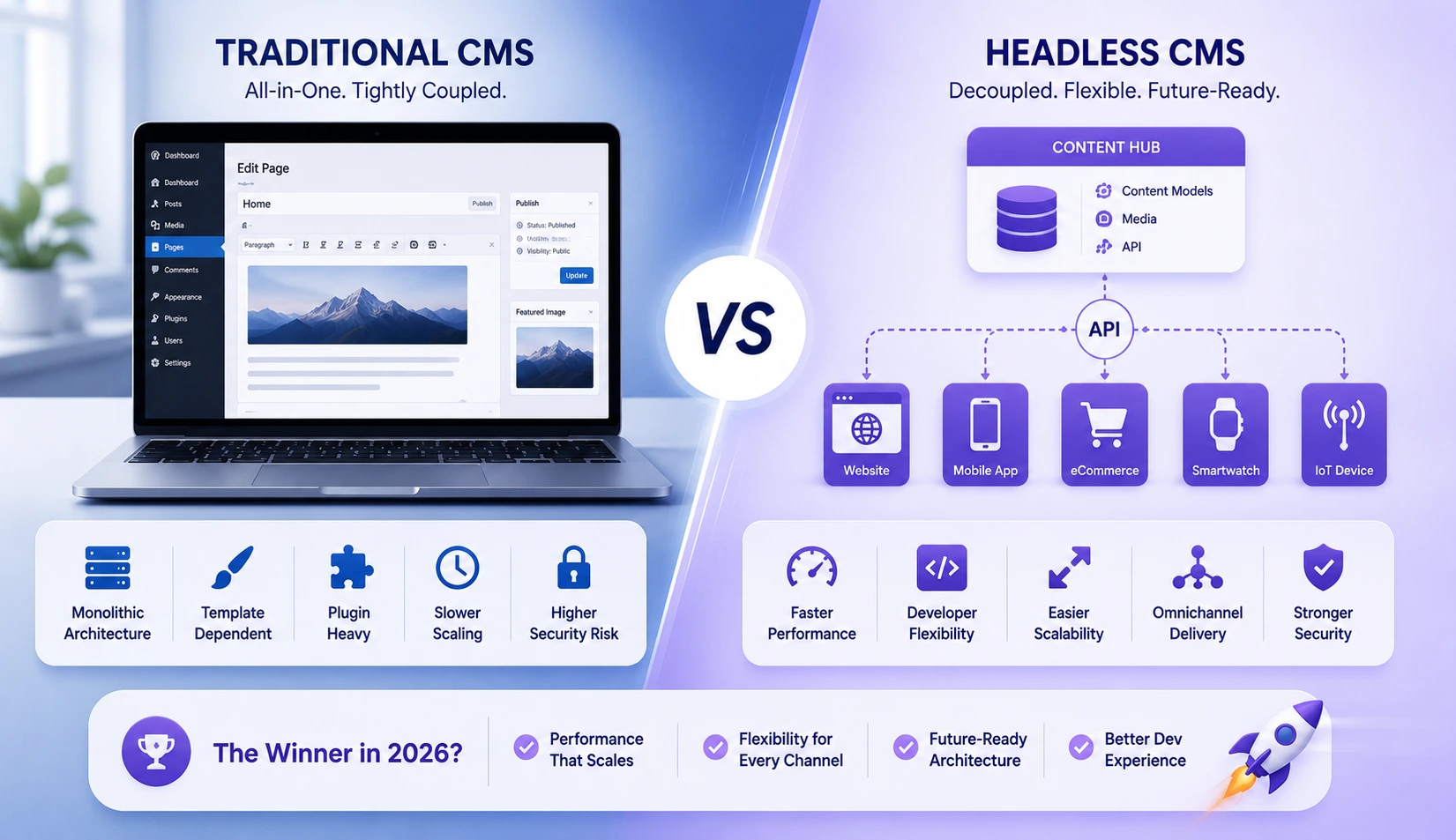
A retail brand we worked with had outgrown their traditional CMS the moment they wanted to launch a mobile app alongside their website using the same product content. Every update meant duplicating work across two disconnected systems. Moving to a headless setup let their team manage content once and publish it everywhere, cutting their content update time significantly.
That’s the core tension behind headless CMS vs traditional CMS. Both approaches still have valid use cases in CMS 2026, and the right choice depends heavily on how many channels a business actually needs to feed content into, especially for headless commerce setups spanning web, mobile, and beyond.
What Separates Headless From Traditional CMS
A traditional CMS bundles content management and content presentation together, meaning the system that stores your content also controls how it’s displayed. A headless CMS separates the two entirely: content lives in a backend system and gets delivered via an API to whatever front end needs it, whether that’s a website, mobile app, or smart display.
When Traditional CMS Still Wins
- Simple websites with a single output channel. If a business only needs a website, and no app or additional platform, the added complexity of headless often isn’t worth it.
- Teams without dedicated developer resources. Traditional CMS platforms typically offer more out-of-the-box themes and page builders requiring less custom development.
- Content teams that need visual, in-context editing. Many traditional CMS platforms let editors see exactly how a page will look while editing, which headless setups often can’t replicate as smoothly.
When Headless CMS Is the Better Fit
- Businesses publishing the same content across multiple channels (web, mobile app, kiosks, voice assistants)
- Teams wanting to use modern front-end frameworks without being tied to a CMS’s built-in templating system
- Fast-growing sites needing better performance, since headless front ends are often faster than traditional CMS-rendered pages
- Businesses planning significant scale, where flexibility outweighs the convenience of an all-in-one system
A Real-World Scenario
A media company running both a website and a mobile app on separate content systems found their editorial team spending hours each week manually copying articles between platforms. After moving to headless, publishing once fed both platforms automatically, freeing up meaningful editorial time for actual content work instead of duplication.
Headless Commerce Considerations
For e-commerce specifically, headless commerce separates the storefront presentation from the backend commerce engine (inventory, checkout, payment processing). This allows businesses to:
- Build fully custom storefronts without being constrained by a commerce platform’s built-in themes
- Deliver consistent product data across web, app, and even in-store digital displays
- Swap out front-end technology later without migrating the entire commerce backend
The tradeoff is development complexity. Headless commerce generally requires a stronger development team than a traditional, all-in-one e-commerce platform.
Common Migration Mistakes
- Moving to headless without a development team capable of maintaining custom front-end code long-term.
- Underestimating the cost and time of a headless migration, treating it as a simple platform swap rather than a structural rebuild.
- Choosing headless purely for its trend appeal without a genuine multi-channel publishing need.
- Failing to plan content modeling carefully upfront, leading to a rigid structure that’s hard to adjust later.
- Ignoring SEO implications during migration, since headless front ends need deliberate attention to metadata and rendering for search engines.
Expert Advice
The decision between headless CMS vs traditional CMS should start with an honest inventory of how many channels content actually needs to reach, not which platform sounds more modern. A business with one website and no immediate plans for additional channels often gets better ROI from a well-configured traditional CMS than from the added complexity of headless.
Conclusion
CMS 2026 doesn’t have a single winning architecture. Headless CMS vs traditional CMS comes down to channel complexity, team capability, and growth plans. Headless commerce delivers real advantages for multi-channel, fast-scaling businesses, while traditional CMS remains a practical, lower-complexity choice for simpler, single-channel sites.
Frequently Asked Questions
1. Is headless CMS always better for SEO?
Not automatically. Headless setups can be faster, which helps SEO, but they require deliberate technical SEO configuration that traditional CMS platforms often handle by default.
2. Do I need a developer to manage a headless CMS?
Generally yes, for both initial setup and ongoing front-end maintenance, unlike many traditional CMS platforms designed for non-technical editors.
3. Can I migrate from traditional to headless CMS gradually?
Yes, some businesses run a hybrid approach during transition, migrating high-priority sections first before a full cutover.
4. Is headless commerce only for large enterprises?
No, but it does require more development investment than an all-in-one commerce platform, making it more cost-effective once a business has outgrown simpler solutions.
5. What’s the biggest reason businesses switch to headless CMS?
Needing to publish the same content across multiple platforms, most commonly a website plus a mobile app, without duplicating editorial work.