
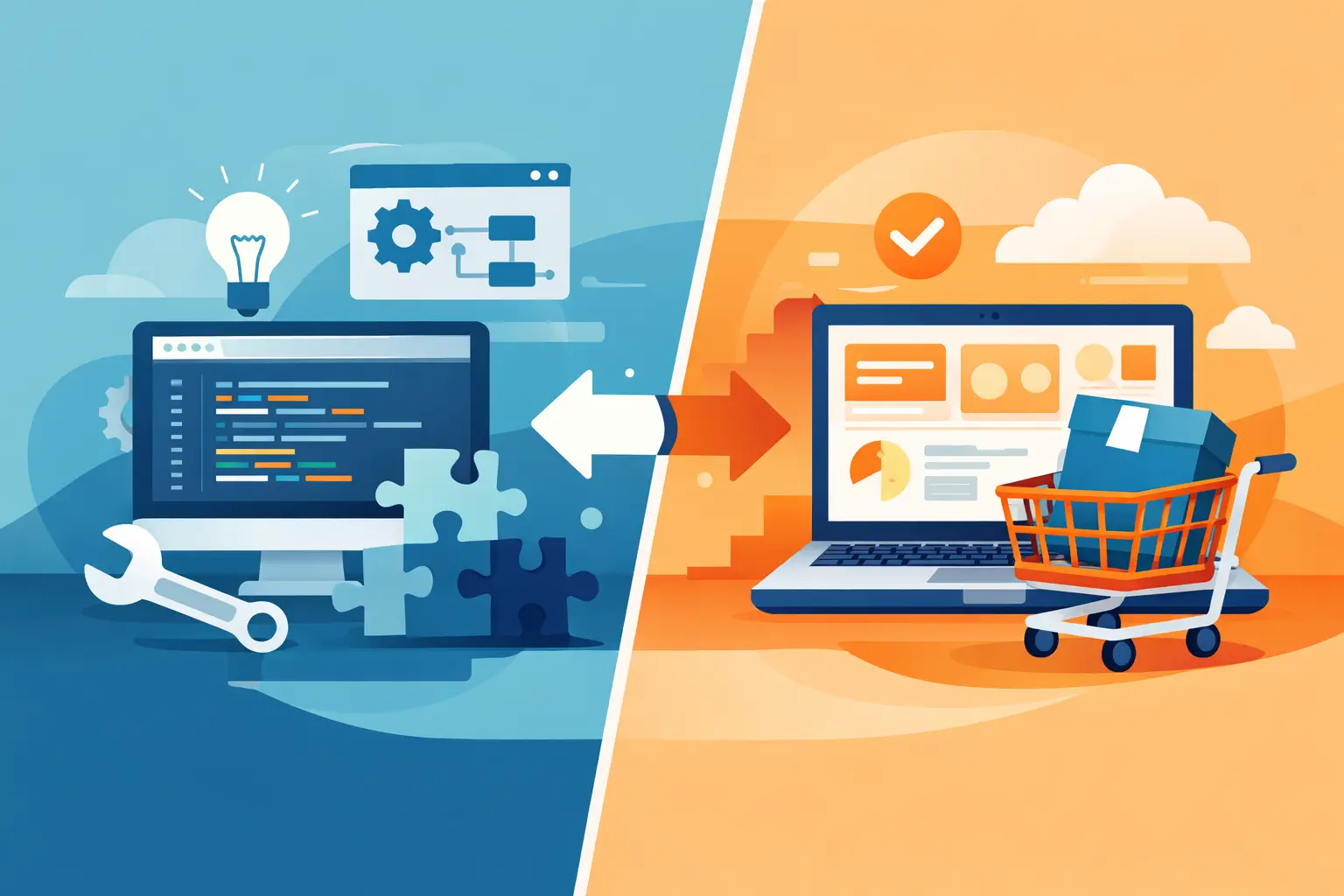
A scheduling platform that cannot reflect how your field teams actually work. A CRM that requires spreadsheets to fill operational gaps. An AI tool that handles one task but cannot connect to your customer data. These are the moments when the build versus buy software decision stops being a technology discussion and becomes a growth decision.
Off-the-shelf software can deliver a fast start. Custom software can create a durable operational advantage. Neither option is automatically right. The better choice depends on whether the software supports a standard process or a process that makes your business distinct, profitable, and easier to scale.
Start With the Business Problem, Not the Platform
Too many software decisions begin with a product demo or a feature list. Start instead with the workflow you are trying to improve. Define who performs the work, where delays occur, what information they need, and what a successful outcome looks like in measurable terms.
For example, a standard payroll, accounting, or team communication need is usually well served by established software. These functions are necessary, but they rarely create a competitive advantage. Buying lets your team use proven capabilities without taking on the cost and responsibility of building them.
The calculation changes when the workflow is central to how you win customers, deliver services, manage risk, or operate at scale. A logistics business may need real-time routing tied to its own fulfillment rules. A healthcare organization may need a secure intake and patient engagement experience that fits its compliance requirements. A growing service business may need automation that routes leads, generates proposals, schedules work, and updates internal systems without manual handoffs.
If the process is core to your differentiation, forcing it into a generic platform can create hidden costs that compound over time.
The Real Build Versus Buy Software Trade-Offs
The decision is not simply custom software versus a monthly subscription. It is a choice between different timelines, ownership models, operating costs, and growth paths.
Buying software optimizes for speed and predictability
Buying is often the right move when the problem is common, the market offers mature products, and your requirements closely match standard functionality. Your team can begin using a proven solution quickly, and the vendor handles most infrastructure, updates, and routine maintenance.
This approach reduces upfront investment and can be especially useful for startups validating a market or businesses replacing manual work with an established system. A subscription product also gives leadership a clearer near-term budget than a custom development project.
But speed at purchase does not always mean speed at scale. Configuration limits, user-based pricing, add-on fees, data restrictions, and weak integrations can become significant once adoption grows. Teams sometimes pay for several tools, then pay again for staff or consultants to move information between them.
Buy when the software supports a non-differentiating process and can meet your needs with minimal customization. If you need to alter the product heavily from day one, you may be purchasing a compromise rather than a solution.
Building software optimizes for control and differentiation
Custom software is designed around your goals, users, workflows, data, and future operating model. You determine the experience, the integrations, the reporting, and the roadmap. That level of control is valuable when software is part of the product you sell or a major driver of operational efficiency.
A custom platform can bring disconnected systems into one governed environment. It can automate decisions across departments, provide customers with a branded portal, apply business rules consistently, and create reporting that reflects the metrics leadership actually uses. It can also be engineered for specific security, compliance, performance, and intellectual property requirements.
The trade-off is responsibility. Building requires thoughtful discovery, architecture, testing, deployment planning, and ongoing maintenance. It also requires a partner or internal team that can distinguish between features that create value now and features that can wait.
Custom development is not an excuse to build everything. The strongest digital products often combine custom workflows and interfaces with carefully selected third-party services for payments, messaging, mapping, authentication, analytics, or other specialized needs.
Calculate the Cost of Delay and Workarounds
A license price is easy to see. The cost of a poor-fit system is not.
Before deciding, quantify the work your current process creates. Consider manual entry, duplicate records, reporting delays, errors, customer response time, missed revenue opportunities, and the management effort required to keep disconnected tools working. A system that saves 20 employees 30 minutes a day creates a business case very differently than one that saves a single user a few clicks per week.
Also look beyond first-year cost. Buying may appear less expensive initially, while subscription increases, premium modules, implementation support, and integration work raise the long-term total. Building requires a larger initial investment, but it may reduce recurring vendor dependence and create a reusable business asset.
The answer depends on the expected lifespan and strategic importance of the solution. A temporary internal process may not justify a custom platform. A system that will support thousands of transactions, customers, or employees for years deserves a more complete financial model.
Test Whether Your Requirements Are Truly Unique
Teams sometimes claim their process is unique when it is simply undocumented. Other times, they assume a process should be standardized because a vendor says it can be configured. Both assumptions are costly.
Separate requirements into three groups: industry-standard needs, business-specific workflows, and future capabilities. Standard needs are candidates for buying. Business-specific workflows deserve closer evaluation. Future capabilities should shape the architecture, but they should not overload the first release.
Ask practical questions. Can an existing product complete the critical workflow without spreadsheets, email workarounds, or frequent exports? Can it integrate reliably with the systems that hold your customer, financial, or operational data? Can it support the permissions, reporting, and audit requirements your organization needs? Can it evolve without forcing a costly migration later?
If the answer is no to several of these questions, a custom solution or a hybrid approach is worth serious consideration.
A Hybrid Approach Often Produces the Best Outcome
Build versus buy software is not always an either-or decision. Many successful organizations buy commodity capabilities and build the layer that connects them into a better business process.
A company might keep its existing accounting platform, use a commercial CRM, and build a custom operations portal that coordinates project delivery, customer communication, approvals, and AI-assisted workflow automation. This avoids rebuilding mature functions that already work while giving the business ownership of the experience that matters most.
Hybrid architecture also supports phased investment. Start with a focused minimum viable product that solves the highest-cost operational problem. Measure adoption and results. Then add integrations, automation, mobile capabilities, or customer-facing features based on evidence rather than assumptions.
This approach requires disciplined architecture. Data ownership, API reliability, security controls, user permissions, and failure scenarios must be planned early. A quick integration that is difficult to maintain can become the next bottleneck.
Use a Decision Framework Your Leadership Team Can Defend
A sound decision should be clear enough to explain to finance, operations, product, and technology stakeholders. Evaluate each option against the same criteria: time to value, total cost over three to five years, workflow fit, integration needs, security and compliance, scalability, data ownership, vendor risk, and strategic differentiation.
Then identify the decision you would regret most. Would you regret investing in a custom product before validating demand? Or would you regret locking a high-growth process into a platform that cannot support your model? This question often reveals more than a feature comparison.
For founders, the right first move may be buying tools to validate the business while planning custom development once customer behavior proves the need. For established businesses, the better move may be modernizing a fragmented legacy workflow before inefficiency limits growth. Enterprise teams may need custom architecture from the beginning when governance, integrations, and security cannot be treated as afterthoughts.
Build for the Next Stage, Not Just the Current Pain
The best technology choice makes the next business milestone easier to reach. That means selecting software based on the organization you are becoming, while avoiding unnecessary complexity today.
SolidAppMaker helps businesses turn that judgment into an actionable product strategy, from workflow discovery and MVP planning through secure development, launch, and long-term maintenance. The goal is not to build custom software for its own sake. It is to invest where technology can remove friction, protect your advantage, and create measurable capacity for growth.
Before signing another contract or approving a development budget, map the workflow, measure the cost of its limitations, and decide what your business needs to own. The right solution is the one that lets your team spend less time working around software and more time moving the business forward.