
A SaaS founder we worked with had built a genuinely powerful internal API to support their own product. Almost as an afterthought, they opened limited access to a few partner companies who’d asked for it. Within a year, that “afterthought” API access was generating a meaningful share of total revenue, with far less support overhead than their core product.
That story repeats across the industry more than most founders realize. API monetization isn’t just for infrastructure giants. Any SaaS business with a genuinely useful API can treat it as API-as-a-product, provided the developer API pricing model actually reflects how customers get value from it.
Why APIs Are Becoming Their Own Revenue Line
As more businesses build software rather than buy it outright, demand for reliable, well-documented APIs has grown steadily. A SaaS company that exposes part of its functionality as an API opens a new customer segment: developers and technical teams who want to integrate specific functionality without adopting the entire platform.
Common API Monetization Models
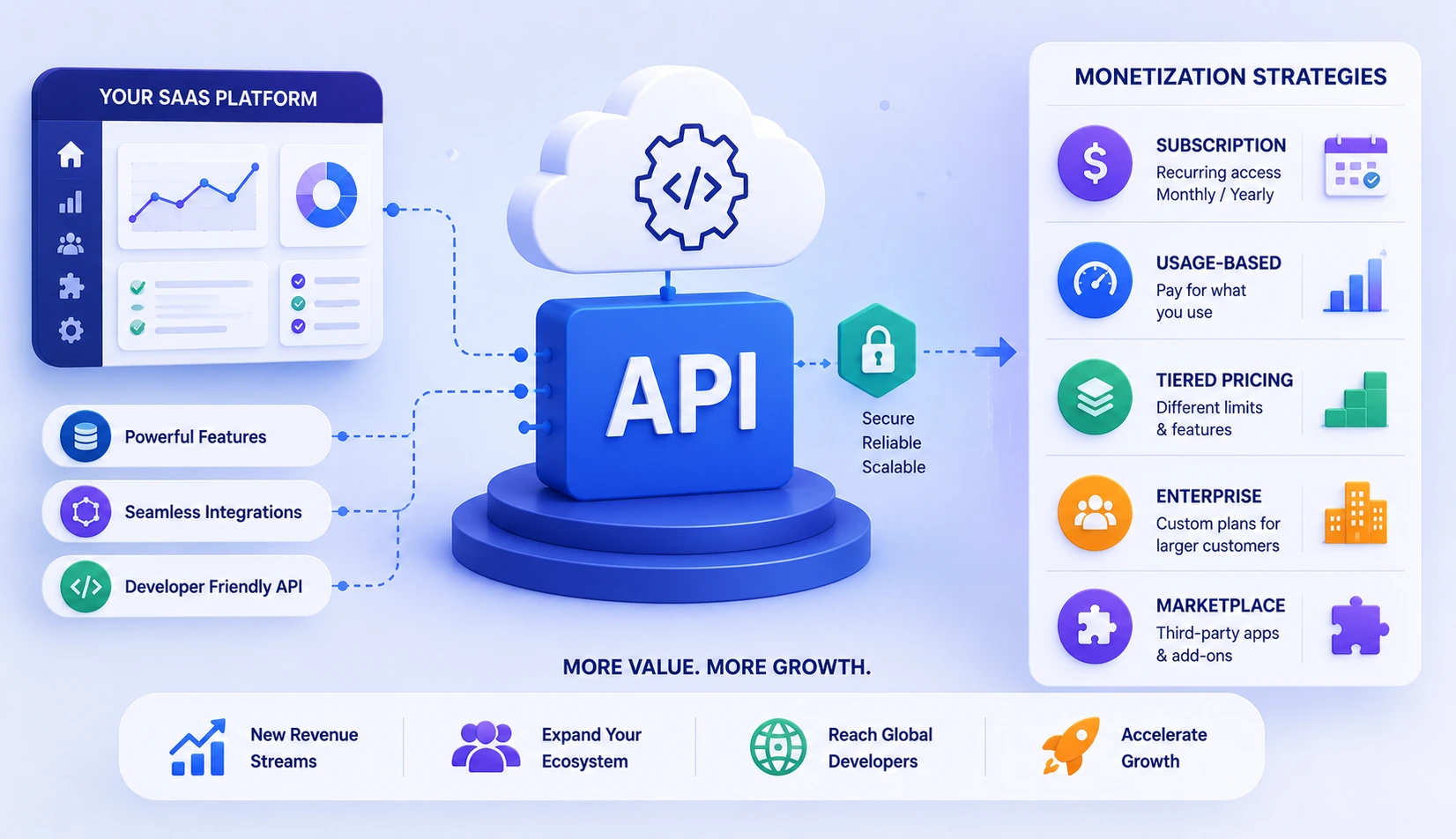
- Pay-per-call pricing. Customers are billed based on the number of API requests made, ideal for usage that scales unpredictably.
- Tiered subscription plans. Fixed monthly pricing tiers include a set number of calls, with overage charges beyond that.
- Freemium access. A limited free tier drives adoption, with paid tiers unlocking higher limits or advanced endpoints.
- Revenue-share partnerships. Particularly common in marketplaces or platforms, where the API provider takes a percentage of transactions processed through it.
- Flat-fee licensing. A fixed price grants access regardless of usage volume, often used for enterprise contracts wanting cost predictability.
A Real-World Scenario
A logistics SaaS company initially charged a flat monthly fee for API access regardless of usage. Larger customers making millions of calls paid the same as small customers making a few hundred, which undervalued the service for heavy users. Switching to a tiered model with clear usage bands increased revenue significantly from their highest-volume customers without losing smaller ones.
Choosing the Right Pricing Structure
- Usage-based pricing fits products where value scales directly with volume (data lookups, transactions processed).
- Tiered subscriptions work well when customers want pricing predictability and usage is relatively stable.
- Freemium models suit products aiming for developer adoption and viral growth before monetizing at scale.
- Enterprise flat-fee licensing fits large customers who value simplicity and predictable budgeting over granular usage tracking.
Most successful API-as-a-product businesses combine models, often freemium for adoption paired with tiered or usage-based pricing once customers scale past a certain volume.
Building the Business Case Internally
- Identify what’s genuinely valuable to expose, distinct from what’s simply technically possible to expose.
- Estimate infrastructure costs per API call, since pricing needs to comfortably cover the actual cost of serving requests at scale.
- Build proper documentation and developer tooling before monetizing, since poor documentation is the single biggest barrier to API adoption.
- Start with a small group of design partners to validate pricing and usage patterns before a public launch.
- Track usage analytics from day one, since pricing decisions without usage data are largely guesswork.
Common Mistakes
- Pricing the API based on internal development cost rather than the value it delivers to customers.
- Launching without adequate documentation, leading to high support burden that erodes the margin advantage of API revenue.
- Ignoring rate limiting and abuse prevention, exposing the business to unexpected infrastructure costs.
- Treating API monetization as a side project rather than assigning clear ownership internally.
- Failing to version the API properly, making future changes disruptive to existing paying customers.
Expert Advice
The SaaS businesses that succeed with API monetization treat developer experience as seriously as their core product’s user experience. Clear documentation, predictable pricing, and reliable uptime matter more to developers evaluating an API than flashy features, since developers are choosing what to build their own business logic on top of.
Conclusion
API monetization strategies work best when developer API pricing reflects real usage value rather than internal cost assumptions. Treating an API as its own product, complete with proper documentation, support, and a pricing model matched to how customers actually derive value, turns what’s often an afterthought into a meaningful, high-margin revenue line.
Frequently Asked Questions
1. Is usage-based or subscription pricing better for API monetization?
It depends on how predictable customer usage is. Usage-based pricing suits variable demand, while subscriptions suit customers wanting budget predictability.
2. Do I need a large customer base before monetizing an API?
No. Even a handful of design partners can validate pricing and demand before a broader public launch.
3. What’s the biggest barrier to API adoption?
Poor documentation. Developers evaluate APIs partly on how easy they are to understand and integrate, not just on functionality.
4. Should a freemium tier be part of every API monetization strategy?
Not necessarily, but it’s effective for products aiming to build a developer community and drive adoption before monetizing at scale.
5. How do I prevent abuse of a pay-per-call API?
Implement rate limiting, usage alerts, and clear terms of service, alongside monitoring for unusual usage spikes that could indicate misuse.