
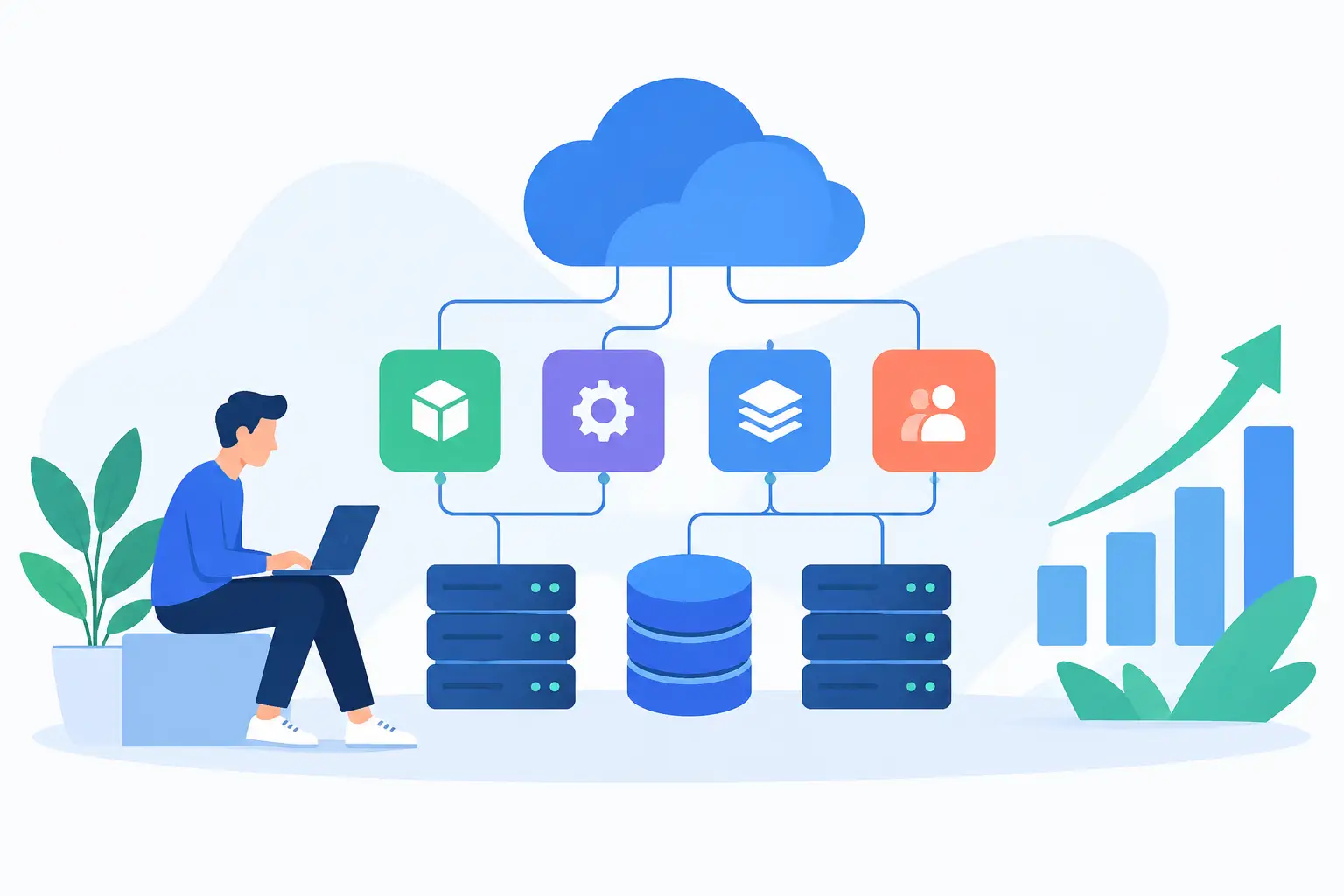
A SaaS product can look simple to customers while carrying serious complexity behind the screen. A user signs in, invites a teammate, connects a payment method, and expects everything to work instantly. Your architecture determines whether that experience stays reliable as customers, data volumes, integrations, and revenue grow. This guide to SaaS product architecture explains how founders and business leaders can make the right early decisions without overengineering an MVP.
The goal is not to choose the most advanced technology stack. The goal is to create a product foundation that supports your commercial model, protects customer data, gives your team room to move quickly, and can evolve when real usage teaches you what matters.
Start SaaS architecture with business decisions
Architecture begins before a developer creates a database or deploys an API. It starts with the operating model of the business. A B2B platform serving regional service companies has different needs from a global fintech product or an internal operations platform sold to enterprise teams.
Define what customers are buying. Are they paying per user, per location, per transaction, or for access to usage-based automation? Will each customer need separate branding, custom approval workflows, unique integrations, or strict data residency rules? These answers shape tenancy, permissions, billing, reporting, and support processes.
It also helps to identify the actions that create value. For an AI workflow product, that may be processing documents, routing support requests, or producing reports. For a field-service platform, it may be dispatching jobs, updating work orders, and notifying customers. Design the first version around these high-value workflows rather than trying to digitize every possible task at launch.
A clear product strategy prevents a common mistake: building an architecture around assumptions that have not been tested with paying users. Your MVP should be capable enough to validate demand and deliver a professional customer experience, but it does not need every enterprise feature on day one.
The core layers of SaaS product architecture
Most SaaS products need several connected layers. The exact tools may change, but the responsibilities should be clear from the beginning.
The experience layer
This is the web application, mobile app, customer portal, or combination of interfaces your users interact with. It should be designed around user roles and real tasks, not just a collection of screens. An administrator may need account controls and reporting, while a frontline user needs a focused workflow that can be completed quickly on a phone.
A responsive web application may be the right first step for many SaaS products. Native or cross-platform mobile development becomes more valuable when users need camera access, location services, offline support, push notifications, or regular field use. The best choice depends on the job users are trying to complete.
The application and API layer
The application layer holds the business rules that make your product distinct. It validates requests, applies permissions, coordinates workflows, and exposes secure APIs to the front end and approved third parties.
Keeping business logic out of the user interface is a practical discipline. When pricing rules, approval processes, or automation logic live in one well-defined service layer, your team can support web, mobile, partner integrations, and future channels without duplicating critical behavior.
APIs should be designed as products, even if they are initially used only by your own application. Use consistent naming, versioning where appropriate, clear error handling, and authentication controls. This reduces friction when customers later request integrations with CRMs, accounting platforms, payment processors, identity providers, or enterprise systems.
The data layer
Your data architecture affects performance, reporting, security, and your ability to make sound product decisions. Most SaaS applications begin with a transactional database for users, accounts, subscriptions, records, and workflow activity. As reporting needs expand, analytics workloads may need to move into separate storage so complex dashboards do not slow down customer-facing transactions.
Establish data ownership early. Know which service is responsible for creating and updating each major record type. Without this discipline, integrations and new features can create conflicting versions of the same customer, order, or operational record.
The infrastructure layer
Infrastructure covers cloud hosting, environments, deployment pipelines, monitoring, backups, and disaster recovery. Customers may never see this layer, but they will feel the effect when an update fails or the product becomes unavailable during a busy period.
Separate development, testing, staging, and production environments. Automate deployments where practical, require code review and testing before release, and maintain a reliable rollback plan. This creates a safer release process without slowing your team down every time the product changes.
Multi-tenancy is a business and security choice
Multi-tenancy means multiple customers use the same software platform while their data and access remain appropriately separated. It is one of the most consequential SaaS architecture decisions because it affects cost, maintenance, customization, and risk.
In a shared multi-tenant model, customers use common infrastructure and application services, with tenant-aware data controls separating their information. This approach is generally efficient and supports faster feature delivery because improvements can be released across the platform.
Some products need stronger isolation. A dedicated database per customer, separate environments for high-value accounts, or a hybrid arrangement can make sense when handling sensitive information, meeting contractual requirements, or supporting highly customized enterprise deployments. The trade-off is higher operational complexity and cost.
For many early-stage SaaS products, a shared application with disciplined tenant identifiers, authorization checks, audit logging, and automated tests offers the right balance. The critical point is that tenant isolation must be built into the product model, not added after customer data has already mixed together.
Security should be designed into every workflow
Security is not a feature reserved for a later release. It is part of how customers decide whether to trust your product, particularly when you handle business records, payments, health-related information, employee data, or proprietary documents.
Start with strong authentication, role-based access controls, secure session management, encryption in transit and at rest, and clear rules for handling secrets such as API keys. Apply the principle of least privilege so users, services, and administrators have only the access they need.
Logging matters as much as prevention. Audit trails help your team investigate changes, resolve disputes, support compliance needs, and identify suspicious behavior. Backups should be tested, not merely scheduled. A backup that cannot be restored is not a recovery strategy.
Security requirements vary by market. A platform selling to enterprise customers may need single sign-on, detailed access reporting, vendor assessments, and formal incident procedures earlier than a small-business product. Architecture should reflect the expectations of the customers you plan to win, not only the customers you have now.
Build for change, not speculative scale
Founders often hear that every SaaS product must begin as microservices. That is rarely the fastest or safest path. A well-organized modular monolith can be easier to build, test, deploy, and understand during the MVP stage. It gives a small team the speed to learn from customers without managing a large number of independent services.
Modularity still matters. Organize the codebase around domains such as identity, billing, notifications, reporting, and core workflows. Define clear boundaries between them. When a specific area creates performance demands, requires independent release cycles, or becomes operationally complex, it can later be extracted into a dedicated service.
Scale is also more than server capacity. Your product must scale operationally. Can support teams diagnose a customer issue? Can account managers see usage data? Can engineers deploy a fix without risking unrelated features? Can your team add a new integration without rewriting core logic? These questions often matter earlier than handling millions of requests per minute.
Plan integrations, automation, and AI carefully
SaaS products increasingly win by fitting into existing business processes. Integrations with payments, calendars, CRMs, accounting tools, messaging platforms, and data sources can make your platform more valuable than a standalone tool.
Use asynchronous processing for slow or high-volume tasks such as sending email, importing large files, generating reports, or calling external systems. Queues and background jobs prevent long-running work from blocking the customer experience. They also make retries and failure handling more manageable.
AI capabilities require the same architectural discipline. If your product uses conversational AI, document analysis, or workflow automation, define what data is sent to the model, how outputs are reviewed, what happens when confidence is low, and how customers can control automated actions. AI should improve a measurable workflow, not become an expensive feature with unclear ownership.
Use a structured delivery process
Architecture decisions are strongest when product, design, engineering, security, and business stakeholders participate early. A structured process moves from discovery and requirements through UX planning, technical design, development, testing, deployment, and ongoing maintenance. Each stage should reduce uncertainty before it becomes an expensive rework request.
At SolidAppMaker, this means treating architecture as a continuing partnership rather than a document delivered at the start of a project. As customer feedback, market demands, and usage patterns change, the product roadmap and technical plan should change with them.
The right SaaS architecture gives your business a dependable platform for learning and growth. Build the first version with clear boundaries, meaningful safeguards, and room to improve. Then let real customer behavior guide the next investment, one valuable release at a time.