
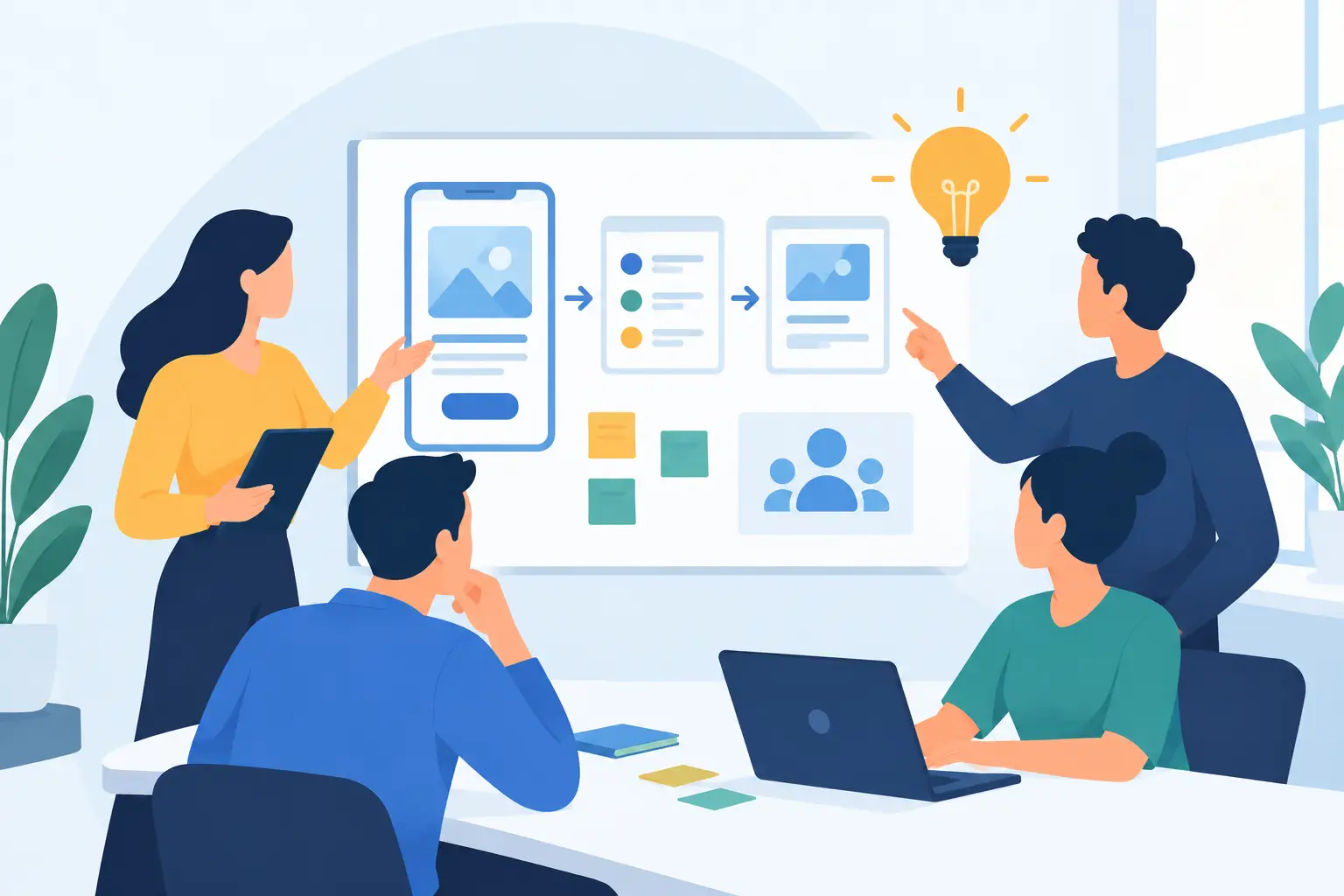
A stalled product project rarely fails because the team cannot write code. It fails because the business commits to features, timelines, and budgets before anyone has defined the problem worth solving. A guide to digital product discovery gives founders and business leaders a more disciplined starting point: align the opportunity, the customer, the operating model, and the technology before development begins.
For a startup, discovery can prevent an expensive MVP from becoming a polished version of the wrong idea. For an established business, it can reveal whether an AI automation initiative, customer portal, mobile app, or internal platform will improve a real workflow or simply add another system to maintain. The outcome is not a pile of documents. It is a practical product plan your team can build, test, measure, and evolve with confidence.
What Digital Product Discovery Is Designed to Solve
Digital product discovery is a structured process for reducing uncertainty before substantial development investment. It examines the commercial case, user needs, current processes, technical constraints, data requirements, and delivery priorities. That work turns a broad statement such as “we need an app” into a decision-ready plan.
The distinction matters. A mobile application is a delivery channel, not a business strategy. An AI assistant is a capability, not proof that customers will use it. Discovery forces the harder questions early: Who has the problem? What are they doing now? What would make them change behavior? How will the company measure success? What must integrate with the new product for it to deliver value?
This process also creates alignment among stakeholders. Owners may focus on revenue, operations leaders on cycle time, customers on convenience, and technical teams on security and maintainability. All of those priorities can be valid, but they need to be ranked. A discovery phase gives the team a shared basis for making trade-offs instead of revisiting fundamental decisions halfway through development.
A Guide to Digital Product Discovery: Start With the Business Case
Begin with the business outcome, not the requested feature set. If a company wants a customer self-service portal, the real objective might be reducing support volume, shortening onboarding, increasing renewal rates, or making account data more visible. Each goal leads to different product decisions.
A useful business case names the target audience, the current cost or missed opportunity, the expected change, and the metric that will show progress. For example, an operations team may aim to reduce manual order-entry time by 40 percent. That target helps determine whether a custom integration, workflow automation, or a broader enterprise platform is the appropriate solution.
The financial case should be honest about uncertainty. New products do not always produce immediate revenue, and operational savings may take time to appear. The point is not to create a perfect forecast. It is to establish why this project deserves investment, what assumptions it relies on, and what evidence would justify moving forward.
Define the problem in observable terms
Avoid broad claims such as “our users need a better experience.” Instead, identify the moment where users struggle. Perhaps a sales representative re-enters the same data in three systems, patients abandon intake forms on mobile devices, or field teams cannot access current inventory information during a service call.
Observable problems lead to testable solutions. They also expose whether the issue is primarily a product issue, a process issue, a data-quality issue, or a training issue. Software may be part of the answer, but it should not be treated as the answer by default.
Learn From Users and the People Who Run the Work
User research does not need to become a months-long academic exercise. It should be focused enough to uncover patterns that affect product decisions. Interviews with customers, employees, partners, or administrators can reveal where friction occurs, what tools are already in use, and which outcomes people value most.
Ask people to describe actual recent behavior rather than hypothetical preferences. “Walk me through the last time you completed this task” produces more useful information than “Would you use an app that does this?” The first question reveals workarounds, approval steps, missing information, and dependency on spreadsheets, email, or legacy systems.
Internal stakeholders deserve the same attention. The person who handles exceptions, corrects records, or responds to escalations often understands the true workflow better than the person who originally requested the product. Their insight is essential when the product will automate a process or connect multiple business systems.
Research should also identify segments that may need different experiences. A first-time customer and a power user do not always need the same workflow. A simple MVP may intentionally serve one high-value segment first. That is not a limitation if it is a strategic choice.
Map the Product Experience Before Designing Screens
Once the team understands the problem, map the end-to-end journey. Consider what happens before a user enters the product, the decisions they make inside it, where data comes from, who receives notifications, and what happens when something goes wrong.
This is where many hidden requirements surface. A user may need identity verification before accessing records. A manager may need approval controls. A customer service team may need visibility into status changes. A new AI-powered workflow may require human review for exceptions. These are not secondary details. They shape the architecture, timeline, and operating model.
Early wireframes and prototypes help transform assumptions into something stakeholders can react to. The purpose is not visual polish. It is validating navigation, content hierarchy, task flow, and the value of the proposed experience before full engineering begins.
A prototype can also clarify what belongs in the first release. If the core user flow delivers value without advanced reporting, extensive personalization, or every edge-case integration, those items can be planned for later. A focused launch is often faster to learn from and easier to support.
Assess Technical Feasibility and Risk Early
A strong discovery process includes technical investigation, not just user research. Teams need to understand the systems that the product will depend on, including APIs, databases, third-party platforms, authentication methods, data ownership, and security requirements.
For example, a conversational AI tool may sound straightforward until the team examines the quality of its knowledge base, the need for access controls, the risk of exposing sensitive data, and the escalation path when the assistant cannot answer correctly. Similarly, an e-commerce upgrade may depend less on front-end design than on inventory synchronization, tax logic, payment requirements, and order-management integrations.
Technical feasibility is not a reason to shut down ambitious ideas. It is a way to choose the right path. Sometimes a custom build is justified because it creates a competitive advantage. Other times, configuring an existing platform and adding targeted integrations produces better time-to-value. It depends on the product’s strategic importance, expected scale, ownership requirements, and long-term operating cost.
Security and scalability should be addressed at this stage as well. A product handling customer data, healthcare information, financial records, or proprietary business information requires deliberate decisions about access, encryption, audit trails, hosting, and retention. Retrofitting these choices after launch is slower and more costly.
Turn Discovery Into a Buildable Roadmap
The final discovery output should give decision-makers clarity without creating unnecessary paperwork. It typically includes a prioritized product scope, user journeys, functional requirements, technical recommendations, integration requirements, architecture direction, delivery phases, budget range, timeline assumptions, and measurable success criteria.
Prioritization is where leadership matters. Every requested feature may have value, but not every feature deserves first-release status. A practical framework separates must-haves from items that improve the experience and items that can wait until real usage data is available. The most important test is simple: if this feature is removed, can the target user still achieve the core outcome?
A roadmap should also explain dependencies. If a launch depends on cleaning customer data, receiving API access from a vendor, or creating legal review processes, those tasks belong in the plan. They are business responsibilities, not surprises for the development team to absorb later.
At SolidAppMaker, discovery is treated as the foundation for structured product execution, from strategic planning through architecture, design, development, testing, deployment, and ongoing maintenance. That continuity matters because the people who understand the original business decisions can help protect them as the product evolves.
Keep Discovery Useful, Not Endless
Discovery can become counterproductive when teams seek total certainty before acting. No amount of planning removes market risk, and customer behavior can change after launch. The goal is to reduce the risks that can be addressed before development while preserving the ability to learn quickly.
The appropriate depth depends on the project. A simple internal dashboard with a known data source may need a shorter discovery cycle. A regulated platform, multi-sided marketplace, AI automation program, or enterprise system replacement requires more investigation because the consequences of a wrong assumption are greater.
Set clear decision points. At the end of discovery, leadership should be able to approve the project, revise the scope, run a targeted validation test, or decide not to proceed. Choosing not to build is sometimes the most valuable result because it protects capital and directs the business toward a better opportunity.
The best digital products begin with more than an idea. They begin with a shared understanding of the customer, the business value, the operating reality, and the path to delivery. When discovery creates that clarity, development stops being a leap of faith and becomes a controlled investment in growth.