
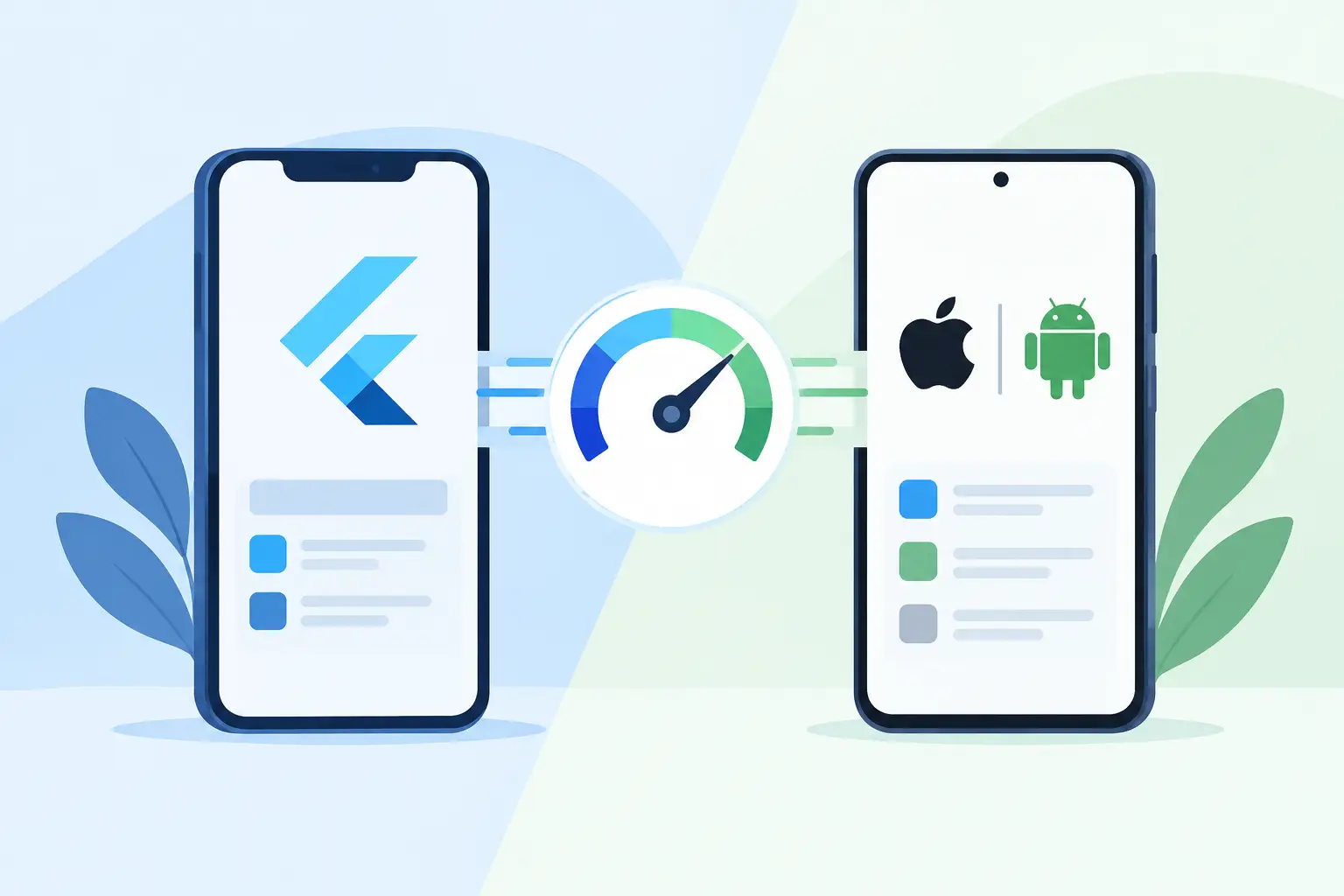
A customer does not care whether an app was built with Flutter, Swift, Kotlin, or a dozen internal services. They care whether it opens quickly, responds instantly, protects their data, and works when they need it. That is why Flutter versus native performance is not simply an engineering debate. It is an architecture decision that affects product adoption, development cost, release speed, and your ability to improve the app after launch.
For many businesses, Flutter delivers performance that is more than sufficient for a polished, high-growth mobile product. For others, native development remains the stronger choice because the product depends on the newest device capabilities, exceptionally demanding graphics, or platform-specific behavior. The right decision starts with what your app must accomplish, not with a preferred framework.
What Flutter versus native performance really means
Native mobile apps are built specifically for each operating system: Swift or Objective-C for iOS, and Kotlin or Java for Android. They use platform tools and APIs directly. Flutter applications use one shared codebase, most often written in Dart, and render much of their interface through Flutter’s own engine.
That distinction changes how each approach handles interface rendering, device integrations, application size, and platform updates. It does not mean that one is automatically fast and the other is automatically slow.
Flutter compiles ahead of time for release builds, which removes the need to interpret code while the user is interacting with the app. Its rendering approach also gives development teams strong control over visual consistency across iOS and Android. Native apps, meanwhile, work directly with each platform’s standard UI components and system layers.
In practical terms, a well-engineered Flutter app can feel exceptionally fast. A poorly designed native app can feel sluggish. Performance comes from architecture, data handling, asset optimization, testing, and thoughtful engineering as much as it comes from the framework itself.
Where Flutter performs extremely well
Flutter is a compelling option when a business needs a single product experience across iOS and Android without funding and coordinating two separate application codebases. Teams can build features once, test them across platforms, and make updates with greater efficiency. That often means faster time to market and lower long-term maintenance overhead.
For business apps, customer portals, marketplaces, booking platforms, subscription products, field-service tools, dashboards, and many commerce experiences, Flutter can deliver fluid screens, responsive navigation, and custom-branded interfaces. Its widget-based UI system is especially useful when your product needs a distinct visual identity rather than a default operating-system appearance.
Flutter can also be a strong choice for MVPs that have a clear path to scale. Launching on both major mobile platforms at the same time creates a larger validation surface for founders and product teams. Instead of splitting early resources between two independent teams, you can concentrate investment on the user experience, backend reliability, analytics, and the features that prove market demand.
The business advantage is not only initial development speed. A shared codebase can reduce the effort required to maintain parity between iOS and Android as the product evolves. That matters when your roadmap includes frequent releases, integrations, workflow automation, or customer-facing improvements that must reach every user quickly.
UI responsiveness and animation
Flutter is capable of smooth animations and responsive interactions, including interfaces that are far more customized than standard form-based applications. However, teams must still manage the rendering workload carefully. Oversized widget trees, unnecessary rebuilds, unoptimized images, and heavy work on the main thread can create dropped frames.
The framework provides the foundation. Disciplined implementation determines whether the experience feels premium.
Network and backend performance
Neither Flutter nor native development can compensate for a slow API, inefficient database query, or overloaded third-party service. In many business applications, users perceive backend delays as app performance problems.
A high-performing mobile product needs efficient API design, caching where appropriate, secure authentication flows, pagination for large data sets, background processing, and useful loading states. These are architecture decisions that should be planned before development begins, regardless of the front-end framework.
When native development has a performance edge
Native development is often the better path when your product sits close to the limits of a mobile device. This can include advanced gaming, intensive 3D rendering, complex real-time video processing, audio production tools, computer vision, augmented reality, or applications that require highly specialized Bluetooth and hardware behavior.
It is also a practical choice when a feature depends on a newly released iOS or Android capability. Native teams can typically adopt the latest platform APIs as soon as they are available. Flutter may require a package update, a custom platform channel, or additional engineering work to expose that capability cleanly.
Platform-specific expectations can matter as well. Apple users and Android users are accustomed to subtle differences in navigation, controls, accessibility patterns, notifications, and system interactions. Flutter can reproduce many of these conventions, but native components offer the most direct alignment with each operating system by default.
For organizations with an existing iOS or Android codebase, rebuilding solely to change frameworks may not produce a meaningful return. The better investment could be performance profiling, app modernization, API improvements, or targeted feature development within the current architecture.
The hidden variables behind mobile app speed
A framework comparison can be misleading when it ignores the operational choices that shape the final product. The following areas often have more impact on performance than the Flutter-versus-native decision alone:
- Startup time, influenced by app size, initialization tasks, authentication checks, and third-party SDKs.
- Memory usage, affected by image handling, caching, background tasks, and long-lived objects.
- API responsiveness, shaped by server architecture, network conditions, query efficiency, and integration quality.
- Battery use, influenced by location services, background refreshes, Bluetooth activity, animations, and inefficient processing.
- Release quality, determined by real-device testing, automated testing, crash monitoring, and a reliable deployment process.
These factors are where experienced product engineering creates measurable value. A feature can look simple on a roadmap yet introduce delays, battery drain, or instability if it is added without an architecture plan.
How to choose the right approach for your product
Start with the product’s highest-risk requirements. If the app’s value depends on advanced device hardware, platform-first experiences, or graphics-intensive processing, assess native development early. Waiting until late in the build to validate those requirements can create costly rework.
If your priority is launching a reliable app on iOS and Android with consistent branding, shared functionality, and an efficient development budget, Flutter deserves serious consideration. It can support sophisticated products when the codebase is designed for growth rather than treated as a quick prototype.
Also consider the full lifecycle. Your app will need operating-system compatibility updates, security maintenance, analytics reviews, performance monitoring, bug fixes, and new features after launch. A choice that seems inexpensive on day one can become costly if the development process makes future changes difficult to test or deploy.
At SolidAppMaker, we approach framework selection as part of product strategy. Before writing production code, we help clients clarify user flows, integrations, security needs, growth plans, and the technical risks that could affect launch. That creates a clearer delivery plan and prevents technology choices from becoming expensive assumptions.
Performance is a partnership decision
Flutter can deliver excellent mobile performance for a broad range of commercial applications. Native development can provide the deepest platform access and the most direct route for highly specialized experiences. Neither option is a shortcut around product planning, quality assurance, or ongoing maintenance.
The strongest mobile apps are built around the work users need to complete, the systems the business must support, and the growth the organization expects after launch. Choose the architecture that supports those realities, then give it the engineering attention required to perform well when your customers are counting on it.