
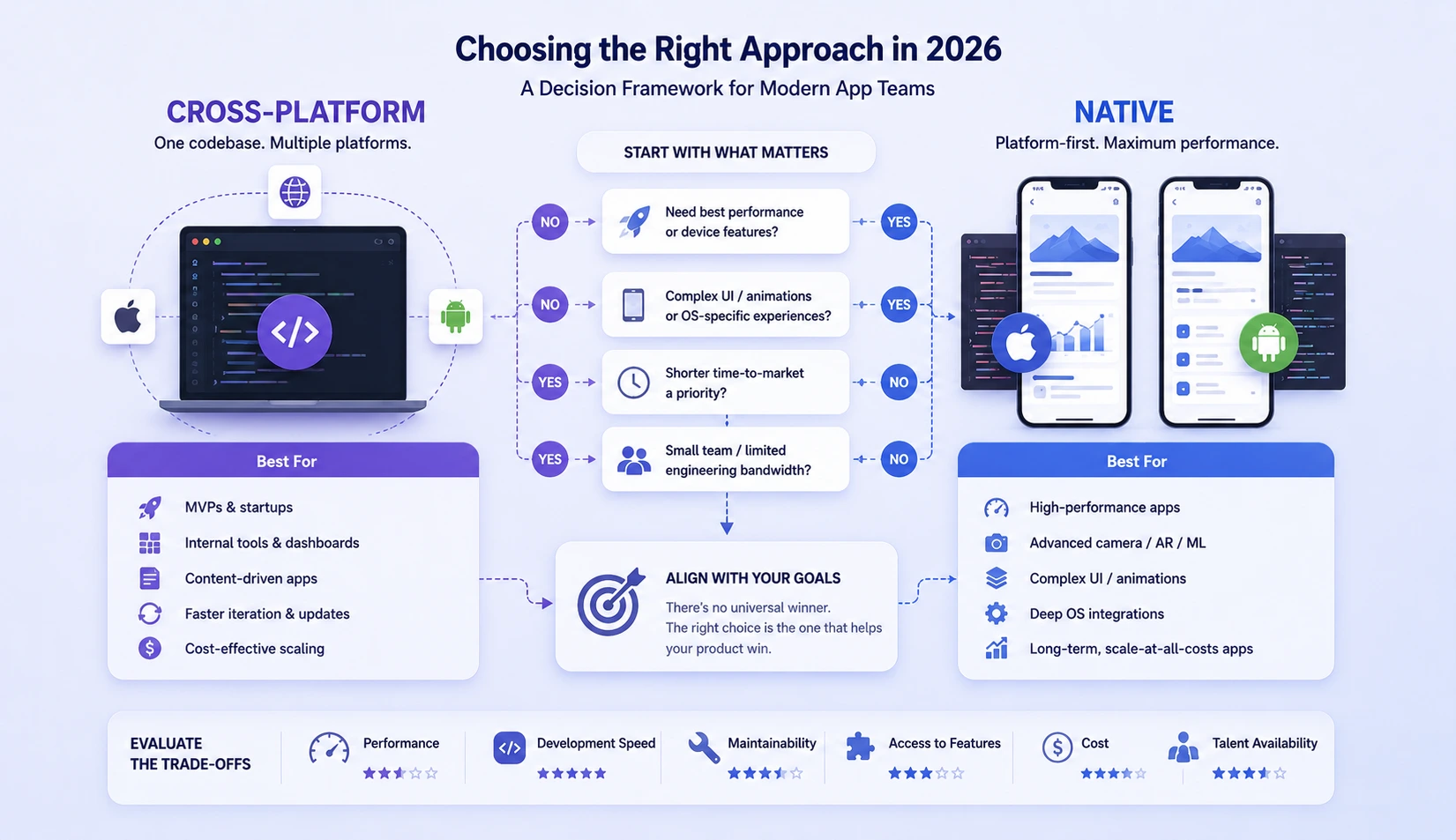
A founder came to us convinced their app needed to be built natively because “that’s what serious apps do.” Their actual use case, a straightforward content and booking app with no heavy device-specific functionality, would have cost nearly twice as much to build and maintain natively for no meaningful performance benefit their users would ever notice.
That’s the pattern we see most often. The native vs cross platform app development decision gets treated as a technology preference rather than a business decision. And the conversation has moved past a simple Flutter 2026 versus React Native 2026 comparison. The real app framework decision depends on what the app actually needs to do, not which framework is trending.
Why This Decision Matters More Than It Used to
Cross-platform frameworks have matured significantly, closing much of the performance and capability gap that once made native development the obvious default. That means the decision now hinges less on “can cross-platform handle this” and more on specific project priorities: budget, timeline, team expertise, and how deeply the app needs to integrate with device-specific features.
When Native Development Is Still the Right Call
- Apps with heavy graphics or performance demands, such as advanced gaming or real-time video processing, where every millisecond of performance matters.
- Apps requiring deep integration with the latest platform-specific features immediately upon release, before cross-platform frameworks catch up with official support.
- Teams with strong existing native expertise and no compelling reason to retrain or hire for a cross-platform stack.
- Apps where platform-specific design conventions are a core differentiator, and users expect the app to feel unmistakably native to their device.
When Cross-Platform Makes More Sense
- Budget-conscious projects needing to launch on both iOS and Android without maintaining two separate codebases.
- MVPs and early-stage products validating a business idea, where speed to market outweighs marginal performance gains.
- Apps with primarily standard UI patterns (forms, lists, standard navigation) that don’t require heavy platform-specific customization.
- Teams needing to move fast with a smaller developer pool, since a single cross-platform codebase requires fewer specialized native developers.
A Real-World Scenario
A healthcare scheduling app needed to launch on both platforms within a tight three-month window ahead of a funding milestone. Building natively for both platforms simultaneously wasn’t feasible with their small team. Choosing a cross-platform framework let one small team ship both versions on time, with performance that was more than sufficient for the app’s relatively standard interface needs.
Flutter vs React Native: Where They Actually Differ Now
- Flutter 2026 compiles to native code directly and renders its own UI components, generally delivering more visually consistent results across platforms and often stronger raw performance for animation-heavy interfaces.
- React Native 2026 has continued closing the performance gap through its newer architecture, and remains a strong choice for teams already deep in the JavaScript and React ecosystem, since it shares more conceptual overlap with web development practices.
- Flutter tends to have a smaller pool of experienced developers compared to React Native’s larger JavaScript talent pool, which can affect hiring timelines and cost.
- React Native benefits from broader community tooling maturity, given its longer track record, though Flutter has closed much of this gap in recent years.
Neither framework is universally “better.” The right choice depends heavily on existing team skill sets and the specific technical demands of the app.
A Practical Decision Framework
- Define the app’s core technical requirements first — does it need heavy device-specific integration, or standard functionality achievable across platforms?
- Assess team expertise honestly. A team strong in JavaScript will move faster with React Native. A team without existing framework bias might lean toward Flutter’s design consistency.
- Estimate long-term maintenance costs, not just initial build cost, since cross-platform typically wins here for standard apps needing updates across both platforms.
- Prototype the highest-risk feature first in the framework being considered, rather than assuming feasibility based on general reputation alone.
- Revisit the decision at major scaling points, since an app’s needs at launch may differ significantly from its needs after substantial growth.
Common Mistakes
- Choosing native development by default without a technical requirement that actually demands it.
- Choosing cross-platform purely for the promise of lower cost, without accounting for time spent working around framework-specific limitations for complex features.
- Ignoring team expertise and choosing a framework based purely on general industry trends.
- Failing to revisit the framework choice as the app’s requirements evolve well beyond its original scope.
- Assuming Flutter and React Native are interchangeable, when their underlying architecture and ecosystem strengths genuinely differ.
Expert Advice
The strongest app framework decision starts with a clear list of the app’s actual technical requirements, not a preference for what feels more modern or more talked about. A straightforward business app rarely needs the performance ceiling native development offers, while a graphics-intensive or deeply platform-integrated app rarely benefits from forcing a cross-platform approach to save initial development cost.
Conclusion
Native vs cross platform app development in 2026 isn’t a debate with one correct answer, and it’s no longer simply a Flutter 2026 versus React Native 2026 comparison either. The right app framework decision comes from matching technical requirements, team expertise, and long-term maintenance realities to the specific app being built, not from following whichever approach is currently trending.
Frequently Asked Questions
1. Is Flutter faster than React Native in 2026?
Flutter often has an edge in animation-heavy or graphics-intensive interfaces due to its rendering approach, though React Native’s newer architecture has narrowed this gap considerably for most standard use cases.
2. Can a cross-platform app access native device features like camera and GPS?
Yes, both major frameworks support this through official and community plugins, covering the vast majority of common device features most apps need.
3. Is native development always more expensive than cross-platform?
Generally yes for apps targeting both iOS and Android, since native requires maintaining two separate codebases, though highly specialized apps may see this cost offset by reduced workaround engineering.
4. Should a startup always choose cross-platform for its first version?
In most cases, yes, particularly for standard business apps prioritizing speed to market, unless the app has specific technical requirements that clearly demand native development.
5. Can an app switch from cross-platform to native later if needed?
It’s possible but typically requires significant redevelopment, so it’s worth carefully evaluating anticipated long-term technical needs before committing to either approach initially.