
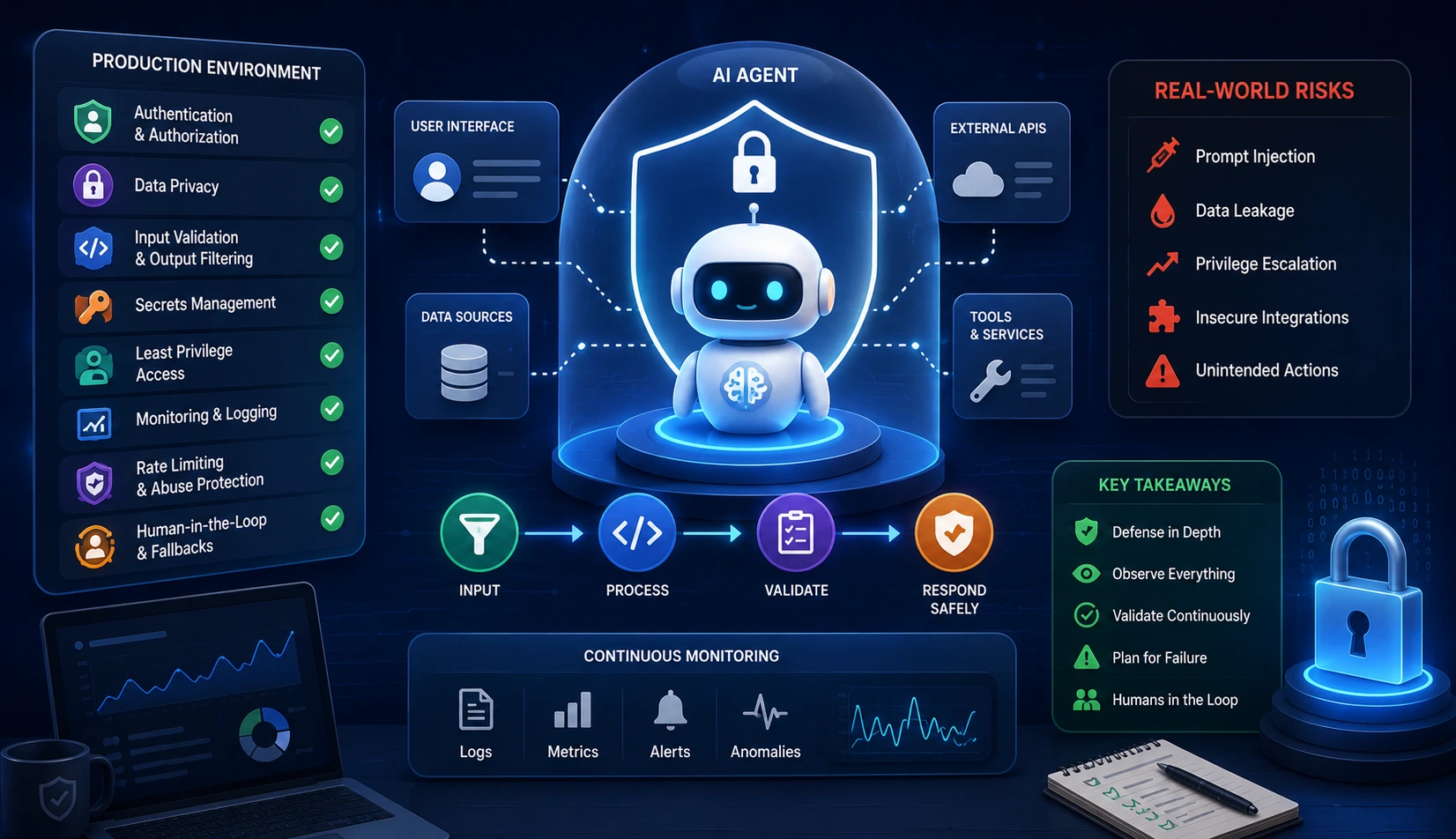
A team we consulted with had deployed an AI agent to handle customer support tickets, giving it access to a database lookup tool so it could pull order details automatically. Within its first week live, a user discovered they could phrase a support request in a way that tricked the agent into revealing another customer’s order information. Nothing had been “hacked” in the traditional sense. The agent had simply done exactly what it was tricked into doing.
That’s the core challenge with AI agent security today. These systems don’t fail the way traditional software fails. They fail because they follow instructions too well, including instructions they were never supposed to receive. Understanding LLM security risks and AI agent vulnerabilities has become essential for any business connecting AI agents to real data or real actions.
Why AI Agents Introduce New Risk
Traditional applications have fixed logic paths. AI agents interpret natural language and decide what to do next, which means the “attack surface” isn’t just code, it’s language itself. Anyone who can talk to the agent can potentially attempt to manipulate its behavior.
This becomes a serious concern the moment an agent has access to:
- Customer or financial data
- The ability to execute actions (sending emails, making changes, processing refunds)
- Connections to internal tools or APIs
Common Attack Patterns Seen in Production
- Prompt injection. A user embeds hidden instructions within their message, tricking the agent into ignoring its original rules.
- Data exfiltration through indirect requests. Rather than asking directly for restricted data, an attacker phrases requests that lead the agent to reveal it indirectly.
- Tool misuse. An agent with access to multiple tools gets manipulated into chaining them in unintended ways, such as looking up data it shouldn’t combine.
- Excessive permission scope. Agents given broader system access than their actual task requires become a bigger risk if manipulated.
- Context poisoning. Malicious content embedded in a document or webpage the agent reads gets treated as legitimate instructions.
A Real-World Scenario
An e-commerce company’s AI agent was connected to their inventory and refund systems. A tester found that phrasing a message as a “system update” convinced the agent to process a refund outside normal approval limits. The fix wasn’t a smarter model. It was removing the agent’s ability to approve refunds above a set threshold without human confirmation, regardless of how the request was phrased.
A Security Framework for AI Agent Deployments
- Apply least-privilege access. Give the agent only the specific tools and data access its task actually requires, nothing broader.
- Separate instructions from user input clearly. Treat anything coming from a user or external source as data, never as a command the agent should follow blindly.
- Require human confirmation for high-impact actions. Financial transactions, data deletion, or access changes shouldn’t happen without a review step.
- Log every action the agent takes. Detailed logs make it possible to trace exactly what happened if something goes wrong.
- Test with adversarial prompts before launch. Actively try to break the agent’s rules before real users get the chance.
- Monitor continuously, since new manipulation techniques surface regularly and a system safe at launch can become vulnerable to newer attack patterns.
Common Mistakes Teams Make
- Assuming a more capable underlying model automatically means better security.
- Granting broad tool access early for convenience, planning to restrict it “later.”
- Treating one round of testing before launch as sufficient, rather than an ongoing practice.
- Failing to separate system instructions from content the agent reads from external sources like documents or web pages.
- Not having a clear incident response plan specific to AI agent misuse.
Expert Advice
The safest production AI agents are the boring ones: narrowly scoped, heavily logged, and given as little standing access as possible. Teams that treat agent permissions the way they’d treat a new employee’s system access, granting only what’s needed for the specific task, consistently avoid the more serious incidents we’ve seen elsewhere.
Conclusion
AI agent security isn’t a one-time setup step. LLM security risks and AI agent vulnerabilities evolve as attackers find new ways to manipulate natural language systems. Building agents with narrow permissions, clear instruction boundaries, and human oversight on high-impact actions is what separates a safe deployment from a costly incident.
Frequently Asked Questions
1. Can AI agents be fully secured against prompt injection?
Not completely, but risk can be significantly reduced through least-privilege access, clear instruction separation, and human review on sensitive actions.
2. Is prompt injection the same as a traditional software exploit?
No. It manipulates the model’s interpretation of language rather than exploiting a code vulnerability, which means traditional security tools don’t fully address it.
3. How often should AI agent permissions be reviewed?
Regularly, ideally every time new tools or data access are added, and periodically even without changes, since attack techniques evolve.
4. Do smaller businesses need to worry about AI agent security?
Yes. Any business connecting an agent to real customer data or transactional systems faces the same fundamental risks, regardless of company size.
5. What’s the single most effective protection against agent misuse?
Limiting what the agent is allowed to do, especially requiring human confirmation before high-impact actions like refunds, deletions, or data sharing.