
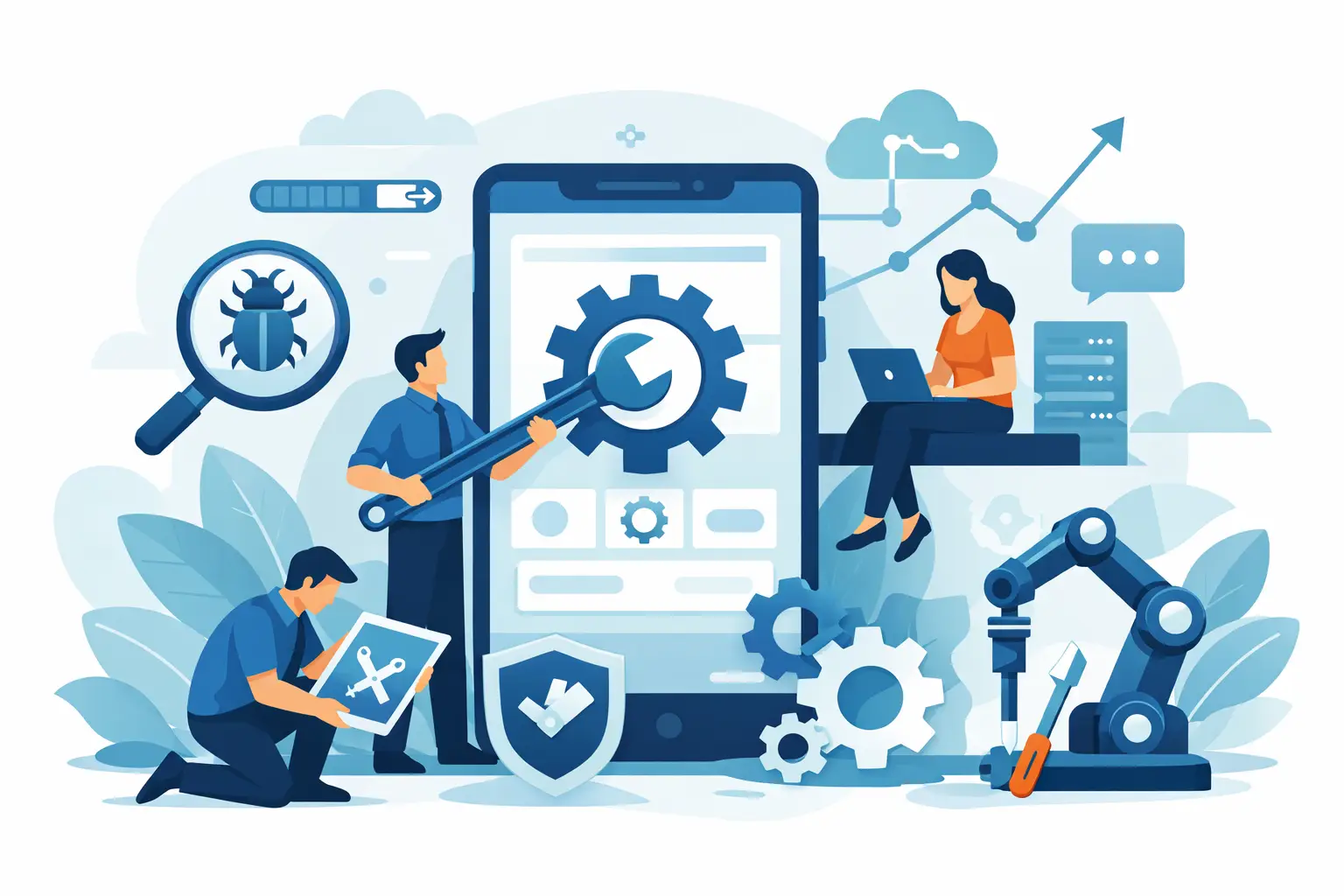
App maintenance and support services are what keep a successful launch from becoming an expensive liability six months later. An application can work well on release day and still lose value quickly when operating systems change, traffic grows, integrations fail, or a newly discovered security vulnerability puts customer data at risk.
For founders and business leaders, the post-launch period is where the real business case for software is tested. Customers expect reliability. Teams expect tools that reduce manual work. Leadership expects the product to support growth without requiring a rebuild every time priorities shift. Meeting those expectations requires an active plan, not a reactive help desk.
Why App Maintenance Is a Growth Function
Many organizations treat maintenance as a cost of keeping the lights on. That view misses the commercial value of a well-managed application. A maintained product is faster to adapt, easier to trust, and less likely to disrupt operations at the wrong moment.
Consider a customer-facing mobile app that depends on payment processing, push notifications, maps, and analytics. Each service may update independently. A change in an iOS or Android requirement can affect app-store approval. A payment API update can interrupt checkout. An analytics tool change can distort the data used to make product decisions. None of those issues is necessarily dramatic on its own, but ignored dependencies create compounded risk.
The same principle applies to internal platforms. A workflow automation tool may save dozens of hours each week until an upstream CRM field changes or an employee permissions rule is updated. Proactive support protects the operational gains that justified the software investment in the first place.
What App Maintenance and Support Services Should Cover
The right support arrangement depends on your product, users, technology stack, and growth plans. A stable marketing website does not need the same coverage as a healthcare platform, an e-commerce application, or a field-service mobile app. Still, effective app maintenance and support services usually combine four connected areas.
- Monitoring and incident response: Tracking uptime, errors, performance, server capacity, and critical user flows helps teams detect issues before customers report them. When an incident occurs, there should be a clear process for triage, communication, resolution, and follow-up.
- Security and compliance upkeep: This includes dependency updates, vulnerability patching, access reviews, backup checks, encryption practices, and secure release controls. For regulated industries, maintenance may also support audit readiness and policy changes.
- Platform and integration updates: Mobile operating systems, browsers, cloud services, third-party APIs, and payment providers evolve constantly. Ongoing compatibility work prevents avoidable breakage.
- Product improvements: Maintenance should reserve room for small enhancements, usability refinements, automation opportunities, and technical improvements that reduce future delivery time.
The distinction between a bug fix and an enhancement matters commercially. A bug is behavior that fails to meet the agreed product requirements. An enhancement is a new or revised capability. Clear definitions prevent scope confusion and let leaders budget appropriately for stability and growth.
Reactive Support Costs More Than It Appears
Waiting for something to break can look economical because there is no recurring support expense. In practice, reactive maintenance often carries higher costs: emergency engineering rates, delayed revenue, employee downtime, customer dissatisfaction, and rushed decisions made without proper testing.
A critical issue also creates a poor environment for strategic work. When internal teams are distracted by a broken login flow or missing order data, planned features, marketing campaigns, and operational improvements are pushed aside. The immediate problem gets fixed, but the business loses momentum.
Proactive support does not mean changing an application every week. It means establishing visibility and ownership so the team can make informed choices. Some updates should be deployed quickly, particularly security patches. Others should be scheduled around peak sales periods, product launches, or internal training needs. Good maintenance is disciplined, not disruptive.
Build a Support Plan Around Business Risk
A support plan should start with the consequences of failure, not a generic package. Ask what happens if the app is unavailable for an hour, if customer data is exposed, if a key integration stops syncing, or if a new mobile OS release affects users. The answers help set realistic service levels and response priorities.
For a startup validating product-market fit, support may focus on fast issue resolution, analytics accuracy, user feedback, and frequent iteration. For an established business with a core operational platform, the priority may shift toward uptime, access controls, backups, audit trails, and predictable release management. Enterprise teams may need formal escalation paths, reporting, and coordination with internal IT or security stakeholders.
It also helps to classify work by severity. A system outage, a security concern, and a minor visual defect should not compete for attention in the same way. Define what qualifies as critical, high, medium, and low priority. Then agree on response targets, update cadence, decision-makers, and the communication channel used during incidents.
Keep Documentation and Ownership Current
Applications become difficult to maintain when knowledge lives only in a former developer’s inbox or in undocumented code. Support work should include practical documentation that allows authorized people to understand how the product operates, how it is deployed, what integrations it uses, and where sensitive credentials are managed.
This does not require turning every client into a software engineer. It means creating the operational clarity needed to make responsible decisions. Product owners should know who owns the domain, cloud account, app-store accounts, source code repositories, analytics tools, and third-party subscriptions. They should also understand renewal dates, permissions, and recovery procedures.
Ownership is especially important when a business works with an external development partner. The strongest relationships are transparent: the client retains control of its intellectual property and core accounts, while the technical team provides the expertise, process, and continuity needed to manage the product well.
Use Maintenance Data to Guide Product Decisions
Maintenance generates valuable evidence about how an application performs in the real world. Error reports can reveal where users abandon a process. Support tickets can show unclear workflows. Performance data may indicate that a particular customer segment experiences slower load times. These signals should inform the product roadmap.
For example, if an internal app receives repeated requests for manual data corrections, the answer may not be faster support. It may be a validation rule, a better approval workflow, or an AI-powered automation that prevents the issue from reaching employees. If customers repeatedly contact support about order status, an improved notification flow may create more value than another marketing feature.
This is where a long-term technology partner adds more than technical labor. The work becomes a structured cycle: monitor the product, resolve urgent issues, identify patterns, prioritize improvements, test changes, and measure results. Maintenance then supports measurable progress rather than merely preserving existing functionality.
Plan Releases Without Creating Avoidable Risk
Every update introduces some level of risk, even when the change is small. The goal is not to avoid releases. It is to manage them with testing, staging environments, backups, rollback plans, and clear approval steps.
A practical release process considers both technical and business timing. Avoid major changes during a large campaign, a seasonal sales peak, or a critical operational window unless the benefit outweighs the risk. Test the most important user journeys before deployment, such as registration, login, checkout, form submission, reporting, or integrations with core systems.
For mobile apps, release planning should also account for app-store review timelines and device testing. For web and enterprise platforms, it may involve browser compatibility, database changes, and coordination with other vendors. The details vary, but the principle stays consistent: controlled change protects customer trust.
Choose a Partner That Can Support the Next Stage
The lowest-cost support option is not always the most affordable over time. A provider that only responds to tickets may be sufficient for a simple, low-risk application. But a product tied to revenue, operations, or customer experience needs a team that understands the architecture, business objectives, and future roadmap.
Look for a partner that can explain technical risks in plain language, document decisions, provide transparent reporting, and scale support as your needs change. The team should be able to handle immediate maintenance while also contributing to modernization, integrations, automation, UX improvements, and strategic planning when the opportunity arises.
SolidAppMaker approaches post-launch work as an extension of product delivery: protect what is working, resolve what is not, and keep the technology aligned with the business you are building. The best time to establish that discipline is before the next critical issue forces the conversation.