
The most expensive technical decisions are often the ones a startup makes before its first customer logs in. A rushed database choice, an unclear integration plan, or an MVP built without a path to scale can turn early momentum into months of rework. Software architecture consulting for startups gives founders a practical way to make those decisions with business goals, product timelines, and future growth in view.
Architecture is not about adding complexity for its own sake. It is about deciding how your product should be structured so it can launch quickly, protect customer data, support the right workflows, and evolve without requiring a full rebuild every time the business changes direction.
What Software Architecture Consulting for Startups Solves
A startup rarely has the luxury of building every feature, hiring every specialist, and perfecting every system before launch. The real challenge is deciding what needs to be built now, what can wait, and which decisions should leave room for the company to grow.
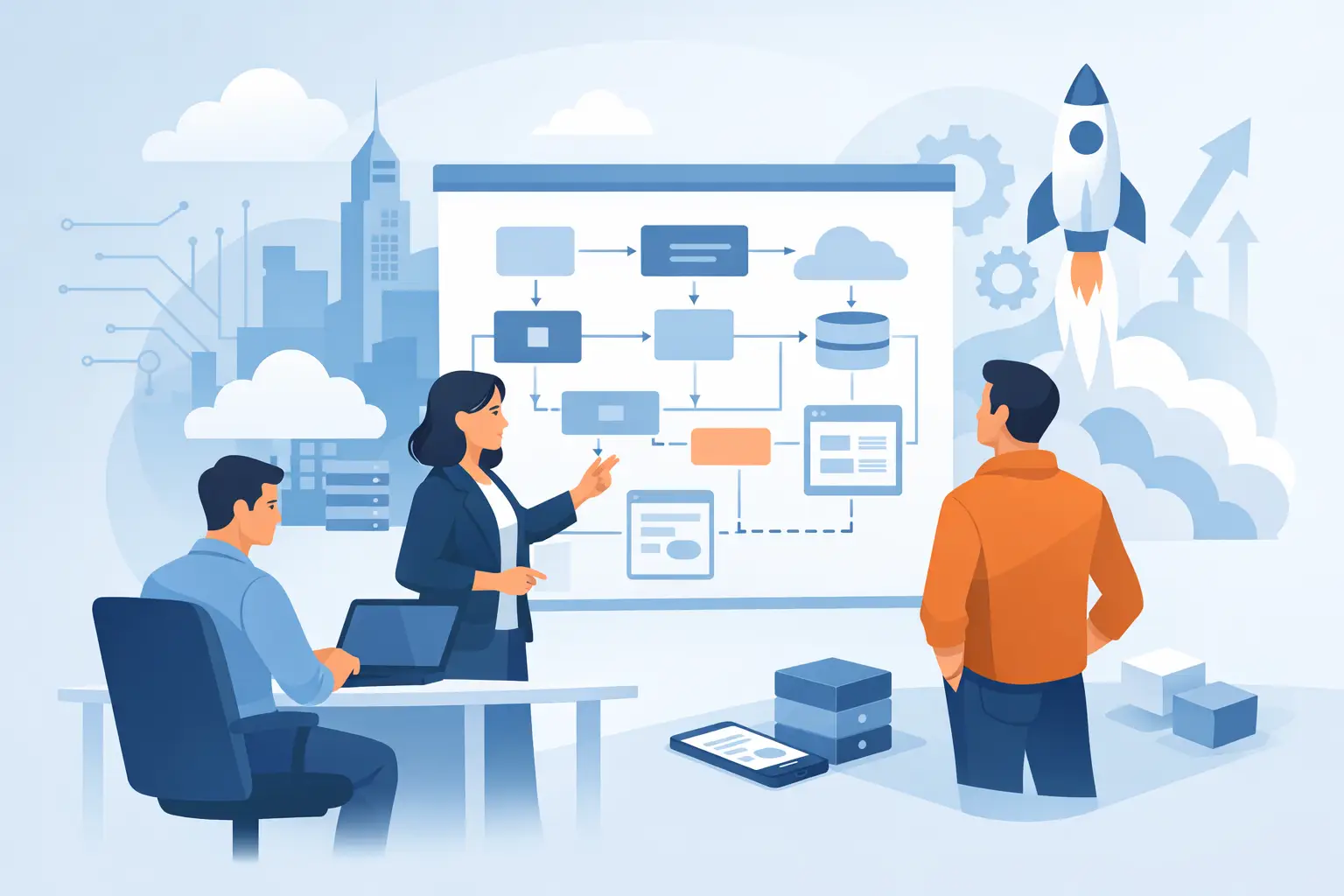
A software architecture consultant helps translate commercial requirements into a technical plan. That plan may cover the application structure, database design, cloud environment, APIs, third-party services, user permissions, security controls, analytics, deployment process, and maintenance needs. More than a diagram, it becomes a decision framework for the product team.
For a nontechnical founder, this creates clarity. Instead of trying to compare programming languages or cloud platforms in isolation, you can evaluate choices based on outcomes: Can we launch an MVP within our budget? Will the platform support customer onboarding? Can it connect with the systems our customers already use? What happens when usage grows tenfold?
For an operations leader or product manager, architecture consulting also reduces surprises. It identifies dependencies early, establishes realistic project phases, and creates shared expectations between business stakeholders, designers, developers, and outside vendors.
Architecture Should Follow the Startup’s Business Model
There is no single best architecture for every startup. A marketplace, a healthcare platform, an AI workflow product, and a mobile-first consumer app have different risks and operating needs.
A founder building a two-sided marketplace may need careful thinking around payments, user verification, location data, notifications, and dispute workflows. A B2B SaaS company may need multi-tenant data separation, role-based access, enterprise integrations, audit logs, and account management tools. A company handling protected health information or financial records needs stronger security and compliance planning from the beginning.
The right recommendation depends on your stage as well. A pre-revenue MVP should not be engineered like a global enterprise platform. Overbuilding consumes budget and delays learning. At the same time, a quick prototype should not create avoidable data security issues or make future integrations impossible.
Good consulting finds the middle ground: build enough structure to protect the business and support the next stage of growth, without paying for capabilities that have no immediate commercial value.
The Decisions That Matter Most Before Development
Early architecture work is most valuable when it addresses the choices that are difficult or costly to reverse later. These usually include the product boundaries, data model, integrations, deployment strategy, and ownership model.
Define the MVP Boundary
An MVP is not simply a smaller version of the final product. It is the smallest product that can test a meaningful business assumption. Architecture consulting helps separate core workflows from supporting features, so the development team can focus on what proves demand.
For example, an AI-enabled operations product may initially need document intake, classification, approval routing, and reporting. It may not need a custom model, a large self-service configuration center, or dozens of integrations on day one. The architecture should make those later additions possible without forcing them into the first release.
Design Data for the Workflows You Sell
Data design affects reporting, permissions, performance, integrations, and customer trust. If customer accounts, transactions, documents, and activity records are not modeled clearly, the product can become difficult to manage as soon as real users introduce exceptions.
Consultants examine which data must be stored, who can access it, how long it should be retained, and what information needs to move between systems. This matters especially for products that use AI automation. AI features need clear data inputs, permission controls, monitoring, and human review paths when outputs affect customers or operations.
Choose Integrations Deliberately
Startups often rely on payments, identity providers, CRM tools, email platforms, analytics, mapping services, and AI services. These tools can speed up launch, but each one introduces cost, dependency, and maintenance requirements.
The question is not whether a third-party service is good. The question is whether it is appropriate for your product, customer expectations, and growth plan. A consultant can identify where a managed service saves time and where owning the capability internally creates a strategic advantage.
Plan for Deployment and Support
A product is not finished when developers complete the code. It needs environments for testing and production, automated deployment practices, backups, error tracking, performance monitoring, and a process for responding to issues after launch.
These elements are often ignored in low-cost builds until the first production problem occurs. Building them into the delivery plan protects uptime, shortens release cycles, and gives the business a clearer picture of operating costs.
When a Startup Needs Architecture Consulting
Not every founder needs a lengthy architecture engagement. If you are validating a simple idea with a landing page or no-code workflow, a focused technical review may be enough. But architecture consulting becomes especially valuable when your product has several moving parts or carries meaningful business risk.
Common signals include:
- You are preparing to build an MVP with a significant development budget.
- Your product needs mobile apps, a web platform, APIs, or multiple third-party integrations.
- You are handling sensitive customer, health, financial, or operational data.
- Different developers or vendors will contribute to the same product over time.
- You need to explain a technical roadmap to investors, enterprise customers, or internal leadership.
It is also useful when a startup already has a product that feels difficult to change. Slow releases, recurring defects, unclear data ownership, rising cloud expenses, and developer handoff problems are often architectural symptoms rather than isolated coding issues.
What a Product-Focused Architecture Engagement Looks Like
The strongest consulting work is collaborative. Founders bring the market knowledge, customer pain points, operating realities, and commercial priorities. The technical team turns those inputs into a build plan that can be delivered and maintained.
The process should begin with discovery. This includes reviewing the product vision, target users, business model, current systems, feature priorities, compliance considerations, and launch timeline. From there, the team can map user journeys and core workflows before deciding how the software should be organized.
Next comes technical planning. This may include architecture diagrams, recommended technology choices, data flows, API specifications, security requirements, integration plans, and estimates for phased delivery. The goal is not to create paperwork that sits unused. It is to give the development team a clear foundation for design, engineering, testing, deployment, and ongoing maintenance.
A practical roadmap should also address trade-offs. A cross-platform mobile framework may reduce initial development time and cost, while native iPhone and Android development can offer more direct control over platform-specific experiences. A modular monolith can be a smart starting point for an MVP, while microservices may make sense later if independent teams and high-volume workloads justify the added operational overhead.
The best answer is usually not the most fashionable technology. It is the approach that supports your product strategy without burdening the team with unnecessary complexity.
Avoid the Two Architecture Extremes
Startups commonly make one of two mistakes. The first is under-planning: building feature by feature with no shared technical direction. This may create early speed, but it often leads to duplicate logic, fragile integrations, inconsistent user permissions, and costly fixes later.
The second mistake is over-engineering. Founders sometimes receive recommendations designed for companies with millions of users, large engineering teams, and mature operational processes. That can lead to long development cycles, high infrastructure bills, and a product that reaches the market too late to learn from customers.
The balance comes from designing for the next meaningful stage, not every hypothetical future. If your next objective is to acquire 100 paying customers, architecture should support that objective while leaving a credible path to 10,000. It does not need to solve every problem a much larger company might have.
Turn Architecture Into a Growth Asset
When architecture is aligned with product strategy, it improves more than engineering quality. It gives founders a clearer investment plan, helps teams estimate work more accurately, and makes it easier to add capabilities such as AI automation, customer portals, mobile applications, and enterprise integrations as demand grows.
It also strengthens ownership. Clear documentation, source code access, deployment procedures, and intellectual property protections ensure the startup is building a durable business asset rather than depending on undocumented knowledge held by a single developer or vendor.
At SolidAppMaker, architecture planning is part of a larger delivery partnership that connects strategy, UX/UI design, engineering, testing, launch, and post-launch support. That continuity matters because the people who help define the foundation can also help evolve it as customer needs and business priorities change.
A useful next step is to put your current product assumptions on one page: the customer problem, core workflow, required data, integrations, security needs, launch goal, and what growth would look like over the next 12 months. That conversation alone can reveal which technical decisions deserve attention before development begins.