
A founder we spoke with last year had built a genuinely useful fitness app, launched it in the US, and picked up a wave of signups from the UK within the first month. Nobody on the team had thought about GDPR. Three weeks later, a user in Germany requested full deletion of their data under GDPR’s “right to be forgotten,” and the team realized they had no process, no data map, and no idea where that user’s information actually lived across their stack.
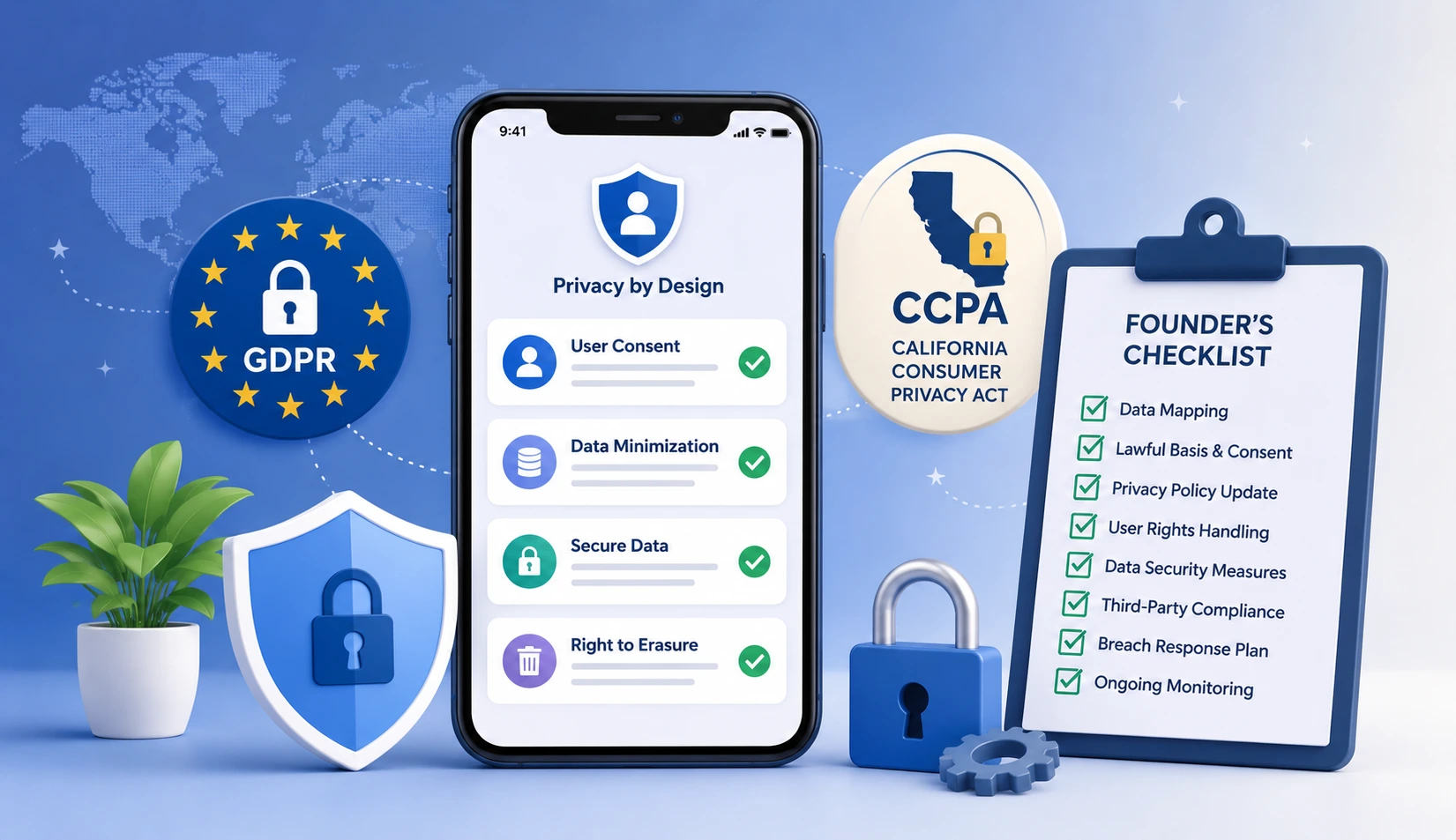
That scramble is avoidable. A data privacy checklist doesn’t need a legal team to get started, just a clear understanding of what GDPR compliance mobile app requirements and CCPA app compliance actually demand, and a system built around them from day one.
Why This Matters Even for US-Based Apps
GDPR applies to any app processing data belonging to EU residents, regardless of where the company is based. CCPA applies once a business crosses certain revenue or data-volume thresholds and serves California residents. Most apps with any organic reach hit one or both within their first year, often before the founders notice.
Non-compliance isn’t just a legal risk. App stores increasingly ask for privacy disclosures at submission, and getting them wrong can delay or block a launch entirely.
GDPR Requirements Every App Needs
- Lawful basis for processing. Every piece of user data collected needs a documented reason: consent, contract necessity, or legitimate interest.
- Explicit, granular consent. A single “accept all” checkbox buried in terms of service doesn’t meet the bar. Users need to opt into specific types of data use (analytics, marketing, third-party sharing) separately.
- Right to access and portability. Users can request a copy of their data in a usable format.
- Right to erasure. Users can request full deletion, and the app needs a real process to execute it across every system that stores that data, not just the primary database.
- Data breach notification. Breaches involving EU user data must be reported to the relevant authority within 72 hours.
A Real-World Scenario
A subscription-based app we advised had user data scattered across their main database, an email marketing tool, an analytics platform, and a customer support ticketing system. When a deletion request came in, it took their team four days to track everything down manually. Afterward, they built a simple internal script that pinged each connected service’s API to confirm deletion, cutting the process to under an hour.
CCPA Requirements Every App Needs
- Right to know. Users can request what categories of data have been collected and why.
- Right to opt out of sale. If user data is sold or shared with third parties for advertising, a clear “Do Not Sell My Personal Information” option must be available.
- Right to non-discrimination. Apps can’t penalize users (with degraded features or higher prices) for exercising their privacy rights.
- Disclosure at collection. Users need to be told what’s being collected at the point of collection, not buried in a policy page they never open.
Building a Compliant Data Flow
- Map every place user data lands — database, analytics tools, crash reporting, email platforms, ad networks.
- Classify data by sensitivity, separating basic account info from anything more sensitive like location or health data.
- Build a consent management layer that logs what each user agreed to and when.
- Create an automated or semi-automated deletion workflow that touches every connected system.
- Update your privacy policy in plain language, not just legal boilerplate, since regulators increasingly check for actual clarity.
Common Compliance Mistakes
- Treating GDPR and CCPA as a one-time policy update instead of an ongoing operational requirement.
- Collecting more data than the app actually uses, which increases both liability and audit complexity.
- Failing to update third-party SDKs (ad networks, analytics tools) on their own data practices, then being held responsible for what those tools do with user data.
- Assuming a privacy policy alone satisfies consent requirements, when active opt-in mechanisms are required.
- Ignoring data retention limits, keeping information indefinitely instead of defining how long it’s actually needed.
Expert Advice for Lean Teams
Startups without a dedicated legal or compliance hire can still get this right by building consent and deletion workflows directly into the product architecture early, rather than retrofitting them later. A basic user data ledger, even a simple internal spreadsheet mapping data types to storage locations, saves enormous time when the first access or deletion request arrives. Treat it as infrastructure, not paperwork.
Conclusion
GDPR compliance mobile app requirements and CCPA app compliance aren’t reserved for large enterprises with in-house legal teams. Any app with real user growth will eventually face a request testing whether these systems actually work. Building consent, access, and deletion into the product from the start turns a stressful compliance scramble into a five-minute process.
Frequently Asked Questions
1. Does GDPR apply if my app is only marketed in the US?
Yes, if any EU residents use the app and their personal data is processed, GDPR applies regardless of where the company is headquartered.
2. What’s the difference between GDPR consent and CCPA opt-out?
GDPR generally requires active opt-in consent before data collection. CCPA operates more on an opt-out model, particularly around the sale of data.
3. How quickly must a deletion request be honored under GDPR?
Typically within one month, though this can be extended in complex cases with notice to the user.
4. Do small startups need a Data Protection Officer?
Only in specific cases involving large-scale processing of sensitive data. Most early-stage apps don’t require one, but should still assign internal responsibility for compliance.
5. Can third-party SDKs create compliance liability for my app?
Yes. If an embedded analytics or ad SDK mishandles user data, the app itself can still be held accountable, so vetting third-party tools matters.