
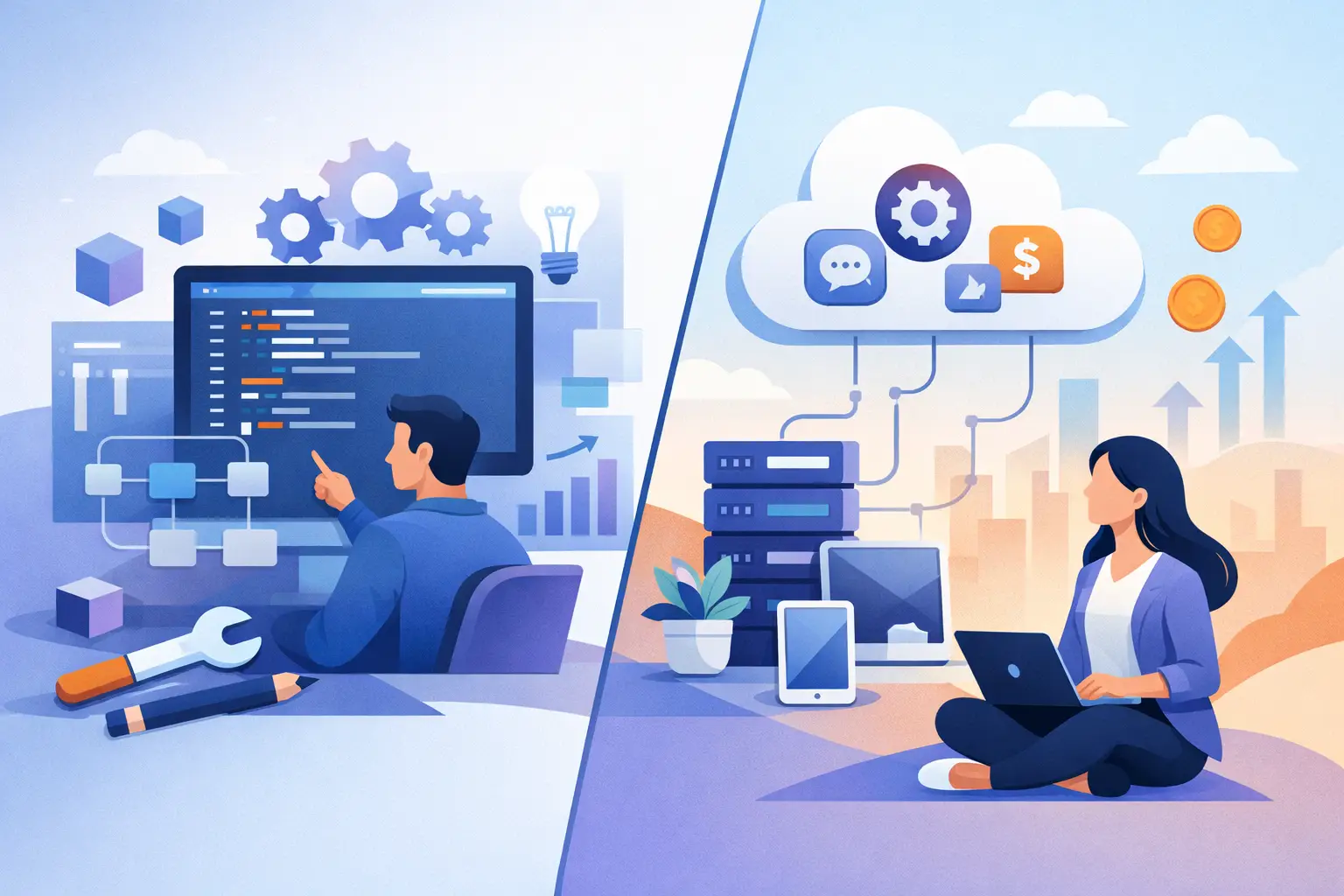
A growing operations team can reach a breaking point fast: customer information lives in one tool, fulfillment in another, and employees spend hours moving data between systems. The custom software versus SaaS decision is not really about whether you prefer buying or building. It is about choosing the technology model that supports your next stage of growth without creating unnecessary cost, complexity, or operational drag.
SaaS platforms can deliver immediate value, especially when a business needs a proven capability such as accounting, email marketing, project management, or video conferencing. Custom software becomes more compelling when the process that makes your business competitive cannot be handled well by a standard product. The right choice depends on the workflow, the economics, the risk profile, and how much control your organization needs over its future.
Custom Software Versus SaaS: The Core Difference
Software as a Service, or SaaS, is a subscription-based product built for many customers. You pay a recurring fee to access features that are already designed, hosted, maintained, and updated by the vendor. Most SaaS products offer configuration options, integrations, and user permissions, but their core architecture belongs to the provider.
Custom software is designed around your business requirements. It may be a customer portal, a mobile app, an AI-powered operations platform, an internal workflow system, or a connected enterprise application. Your organization defines the priorities, owns the product direction, and can build the data flows and user experiences that match how your teams and customers actually work.
Neither approach is automatically better. A startup validating a new idea may need a SaaS stack to move quickly. A logistics company with a unique dispatch process may lose money every day it tries to force its operation into a generic platform. The strategic question is whether software should adapt to your business or whether your business can reasonably adapt to the software.
When SaaS Is the Smarter Business Move
SaaS is often the strongest option when the business problem is common and the available products already solve it well. A company does not need to build its own payroll platform, business email suite, or meeting software simply to prove it can. Using established products for standardized functions preserves capital and lets the team focus on the work that differentiates the company.
Speed is the clearest SaaS advantage. A team can often configure a platform, train users, and begin operating in days or weeks rather than waiting through a design and development cycle. Subscription pricing can also make initial budgeting easier because costs are distributed over time instead of concentrated in an upfront project investment.
SaaS vendors also carry much of the maintenance responsibility. They manage hosting, routine upgrades, bug fixes, and baseline security practices. For smaller teams without internal technical resources, that reduced operational burden has real value.
However, fast setup should not be confused with a complete solution. Many businesses begin with a tool that appears affordable and simple, then add more subscriptions to cover reporting gaps, approval rules, data handoffs, or customer-facing needs. Over time, the monthly software stack grows, integrations become fragile, and employees develop manual workarounds. SaaS can be efficient, but only when its workflow is close enough to yours.
When Custom Software Creates a Stronger Advantage
Custom software is best suited to processes that are central to revenue, customer experience, operational efficiency, or intellectual property. If your team has a repeatable process that competitors cannot easily match, turning that process into a well-designed system can make it faster, more reliable, and easier to scale.
Consider a service business that assigns jobs based on location, technician credentials, contract terms, inventory availability, and service-level agreements. A standard field service platform may cover 70 percent of the need. The remaining 30 percent may require spreadsheets, phone calls, duplicate data entry, and constant management oversight. That gap is not minor if it affects margins, response times, and customer retention every day.
A custom platform can automate those decisions, connect to existing systems through APIs, provide role-specific dashboards, and create a better experience for customers and employees. It can also evolve as the company adds locations, services, pricing models, or compliance requirements.
Control is another major consideration. With custom software, you are not dependent on a vendor’s feature roadmap, pricing changes, acquisition decisions, or product retirement timeline. You can prioritize the capabilities that matter to your business and retain ownership of the application and its underlying intellectual property according to the terms of your engagement.
That control comes with responsibility. Custom software requires thoughtful discovery, architecture, testing, deployment, and ongoing maintenance. It is not a one-time purchase that can be ignored after launch. The strongest custom products are managed as long-term business assets with a clear roadmap, performance monitoring, security updates, and continuous improvement.
Compare Total Cost, Not Just the First Price
The cost comparison between custom software and SaaS is rarely as simple as project fee versus monthly subscription. A SaaS product usually has a lower entry cost, while custom development requires greater upfront investment. But a useful decision includes the full cost of operating each model over several years.
For SaaS, look beyond the base plan. Include per-user fees, premium modules, implementation charges, consulting, training, integration tools, data storage, contract increases, and the labor spent on manual workarounds. If critical data must be copied among systems, calculate the hours involved and the cost of errors that follow.
For custom software, account for discovery, UX and UI design, development, quality assurance, cloud infrastructure, third-party services, maintenance, and future enhancements. A responsible development partner should make these cost areas visible early rather than treating them as surprises after launch.
The key is to connect cost to business value. If a custom system eliminates five hours of manual work per employee each week, reduces costly fulfillment errors, or supports a new revenue channel, its return may outweigh the upfront investment quickly. If it merely recreates a feature that a mature SaaS product already provides, building it may be an expensive distraction.
Security, Data, and Integration Change the Decision
Security requirements can shift the balance toward custom software, particularly for organizations handling sensitive customer information, regulated data, proprietary workflows, or complex internal access rules. A capable SaaS vendor may offer strong security controls, but you still need to confirm where data is stored, how it is processed, what audit records are available, and how access is managed.
Custom applications allow your organization to design security around specific roles, approval paths, retention requirements, and system boundaries. That does not make custom software inherently secure. Security depends on disciplined architecture, secure coding, testing, access controls, infrastructure configuration, and maintenance. The advantage is precision: you can build the safeguards your operating model requires instead of accepting a generalized approach.
Integration deserves the same attention. A SaaS platform with native integrations may be ideal for a straightforward technology stack. But when multiple business systems must exchange data in real time, a custom integration layer or central platform can reduce duplication and give leaders more reliable reporting. This is often where AI automation delivers practical value, turning fragmented handoffs into controlled workflows with clear ownership.
A Practical Decision Framework
Before choosing a path, leadership teams should assess four areas together:
- Strategic importance: Is this capability central to how you win customers, deliver service, or generate revenue?
- Workflow fit: Can an existing platform support the process with minimal compromise, or are workarounds already consuming time and creating risk?
- Scale and change: Will the system need to support new locations, users, offerings, data volume, or business rules in the next two to three years?
- Ownership and risk: How much control do you need over data, integrations, user experience, compliance, and the product roadmap?
If the capability is standard, the workflow fit is high, and speed matters most, SaaS is usually the practical answer. If the capability is strategic, the process is unique, and operational friction is growing, custom software deserves serious consideration.
There is also a third option: a hybrid approach. Many successful organizations use SaaS for commodity functions and custom software for the workflows that create competitive value. A custom customer portal, mobile app, AI workflow engine, or reporting layer can connect proven SaaS tools without requiring the business to replace everything at once.
Build Only What Moves the Business Forward
Custom development should begin with the business problem, not a feature list. Define the users, decisions, data sources, bottlenecks, success metrics, and risks. Then determine the smallest valuable version that can produce measurable progress. For a startup, that may be an MVP that validates customer demand. For an established company, it may be a focused automation initiative that removes one costly operational bottleneck before expanding into a broader platform.
A structured delivery process matters here. Discovery aligns technology with commercial goals. Architecture determines how the system will scale and integrate. Design makes the product usable. Development, testing, deployment, and maintenance turn the plan into a dependable business capability. This approach gives stakeholders visibility while reducing the risk of investing heavily in features that do not create value.
The best technology decision is the one that gives your team more capacity to serve customers, make better decisions, and grow with confidence. If you are weighing custom software versus SaaS, start by measuring the cost of the problem you are trying to solve. That number will tell you far more than a subscription price or a development estimate ever can.