
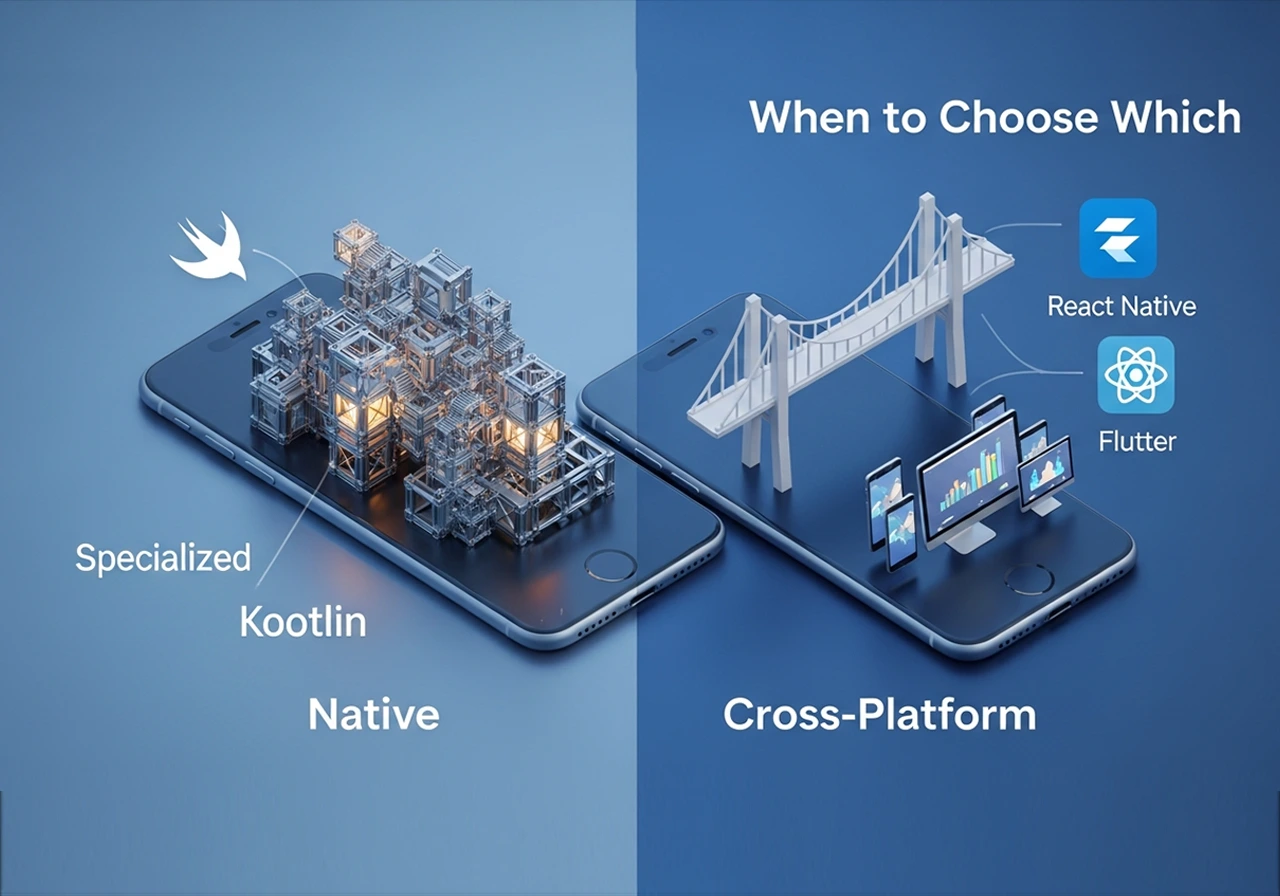
Choosing between native and cross-platform development is one of the most critical decisions you’ll make when building a mobile application. This choice affects everything from your development timeline and budget to your app’s performance and user experience. Let’s dive deep into both approaches to help you make an informed decision for your next project.
Understanding the Fundamentals
Native development means building separate applications for each platform using platform-specific programming languages and tools. For iOS, you’d use Swift or Objective-C with Xcode, while Android development typically uses Kotlin or Java with Android Studio. Each app is built from the ground up specifically for its target platform.
Cross-platform development takes a different approach by allowing you to write code once and deploy it across multiple platforms. Popular frameworks like React Native, Flutter, and Xamarin enable developers to create applications that run on both iOS and Android from a single codebase, dramatically reducing development time and resource requirements.
The Native Development Advantage
Native apps offer several compelling benefits that make them the preferred choice for certain projects. Performance stands at the forefront of these advantages. Because native apps are built specifically for their target platform, they can fully leverage the device’s hardware capabilities without the abstraction layer that cross-platform solutions require. This translates to smoother animations, faster load times, and more responsive interfaces, particularly crucial for graphics-intensive applications like games or augmented reality experiences.
The user experience in native apps feels inherently more polished and intuitive. Native applications automatically adopt platform-specific design patterns, gestures, and navigation paradigms that users expect. An iOS app will feel distinctly like an iOS app, with familiar interactions like swipe gestures and navigation patterns. Similarly, Android apps naturally incorporate Material Design principles and Android-specific UI elements. This platform consistency creates a sense of familiarity that users appreciate.
Access to the latest features represents another significant advantage. When Apple or Google releases new APIs, hardware capabilities, or platform features, native developers can implement them immediately. Cross-platform frameworks must wait for their maintainers to create wrappers or bridges to these new capabilities, which can take weeks or months. If your app needs to be on the cutting edge of innovation, native development removes this waiting period.
The development tools for native platforms are robust, mature, and backed by tech giants. Xcode and Android Studio provide comprehensive debugging tools, performance profilers, and interface builders that streamline the development process. The documentation is extensive, and the developer communities surrounding these platforms are massive, making it easier to find solutions to problems.
The Cross-Platform Case
Cross-platform development has evolved dramatically in recent years, with frameworks like Flutter and React Native achieving performance levels that approach native applications. The primary appeal lies in the dramatic reduction of development time and cost. Writing one codebase instead of two means you can build, test, and maintain a single application that works across platforms. This efficiency can reduce development costs by 30-40% compared to building separate native apps.
Team structure becomes much simpler with cross-platform development. Instead of maintaining separate iOS and Android teams with different skill sets, you can have a unified development team working in a single technology stack. This consolidation simplifies hiring, reduces communication overhead, and creates a more cohesive development process. A smaller team can accomplish what would traditionally require larger, specialized groups.
Faster time-to-market often determines business success in competitive markets. Cross-platform development allows you to launch on both major platforms simultaneously, capturing the entire mobile market at once. When you need to make updates or fix bugs, you only need to do it once, and the changes propagate to both platforms. This agility can be a significant competitive advantage.
Modern cross-platform frameworks have matured considerably. Flutter, backed by Google, uses the Dart language and renders its own UI components, achieving near-native performance. React Native, maintained by Meta, leverages JavaScript and allows direct manipulation of native components. These frameworks provide extensive libraries, strong community support, and regular updates that keep pace with mobile platform evolution.
Performance Considerations in Detail
The performance gap between native and cross-platform apps has narrowed significantly, but differences remain in specific scenarios. Native apps excel in computation-heavy tasks, complex animations, and scenarios requiring intensive use of device sensors or camera functions. Video editing apps, high-end games, and augmented reality applications typically demand the raw performance that native development provides.
Cross-platform apps perform admirably for most business applications, social media apps, e-commerce platforms, and content-driven applications. The framework overhead becomes negligible for apps where the primary bottleneck is network requests rather than local computation. Modern cross-platform frameworks use sophisticated optimization techniques, including ahead-of-time compilation and direct rendering to platform graphics engines, minimizing performance penalties.
When to Choose Native Development
Choose native development when performance is non-negotiable. If your app involves complex animations, heavy data processing, or real-time interactions like gaming or video streaming, native development provides the headroom you need. Apps that push hardware limits benefit from direct access to platform capabilities without intermediary layers.
Platform-specific features should drive you toward native development when they’re central to your app’s value proposition. If you’re building an app that heavily utilizes the latest iOS or Android features, ARKit, Apple’s Core ML for machine learning, or Android’s specific camera APIs, native development ensures you can leverage these capabilities fully and immediately.
Long-term applications with evolving feature sets benefit from native development. While the initial investment is higher, the flexibility to adopt new platform features as they emerge, combined with typically better long-term maintainability for complex apps, can justify the upfront cost. Enterprise applications expected to remain in service for years often choose native for these sustainability reasons.
Teams with existing native expertise should leverage those skills. If you already have experienced iOS and Android developers, building native allows you to capitalize on their deep platform knowledge and avoid the learning curve of adopting a cross-platform framework.
When Cross-Platform Makes Sense
Startups and MVPs represent the sweet spot for cross-platform development. When you need to validate your idea quickly across both major platforms without burning through your budget, cross-platform frameworks provide the ideal solution. You can test market fit and user reception before committing to more expensive native rewrites if necessary.
Budget constraints make cross-platform development attractive. If you’re working with limited resources and need to maximize your development budget, building once for both platforms stretches your dollars further. The savings can be redirected toward marketing, user acquisition, or additional features.
Content-focused and business applications thrive on cross-platform frameworks. If your app primarily displays information, handles forms, manages data, or facilitates communication, cross-platform development delivers excellent results. Apps like social networks, news readers, e-commerce stores, and business management tools work beautifully in React Native or Flutter.
Rapid iteration cycles favor cross-platform development. When you need to experiment with features, gather user feedback, and make frequent updates, the ability to modify a single codebase accelerates your iteration speed. This agility proves invaluable during the early stages of product development.
Hybrid Approaches and Future Considerations
Many successful companies adopt a hybrid strategy, using cross-platform development for most of their app while implementing performance-critical features in native code. Both React Native and Flutter support native modules, allowing developers to write platform-specific code when necessary. This approach balances development efficiency with performance optimization.
The future of app development continues to favor cross-platform solutions as frameworks mature and performance gaps narrow. Progressive Web Apps (PWAs) represent another alternative, offering app-like experiences through web technologies. However, for applications requiring deep system integration or offline-first functionality, native and cross-platform frameworks remain superior choices.
Making Your Decision
Your decision should be driven by a clear understanding of your priorities. Map out your requirements, constraints, and long-term vision for your application. Consider factors like budget, timeline, team composition, performance requirements, and feature complexity.
Don’t hesitate to prototype. Building small proof-of-concept applications in different frameworks can provide invaluable insights into how each approach fits your specific needs. Many development teams find that hands-on experimentation reveals practical considerations that aren’t apparent from theoretical comparisons.
Remember that your choice isn’t permanent. Many successful apps have transitioned from cross-platform to native as they scaled, while others have moved from native to cross-platform to improve development efficiency. The key is choosing the approach that best serves your current needs while remaining adaptable to future changes.
At SolidAppMaker, we’ve worked with both native and cross-platform projects, and we understand that the right choice depends entirely on your unique situation. Whether you’re building the next breakthrough app or solving a specific business need, understanding these trade-offs empowers you to make decisions that align with your goals, resources, and vision for your mobile application.