
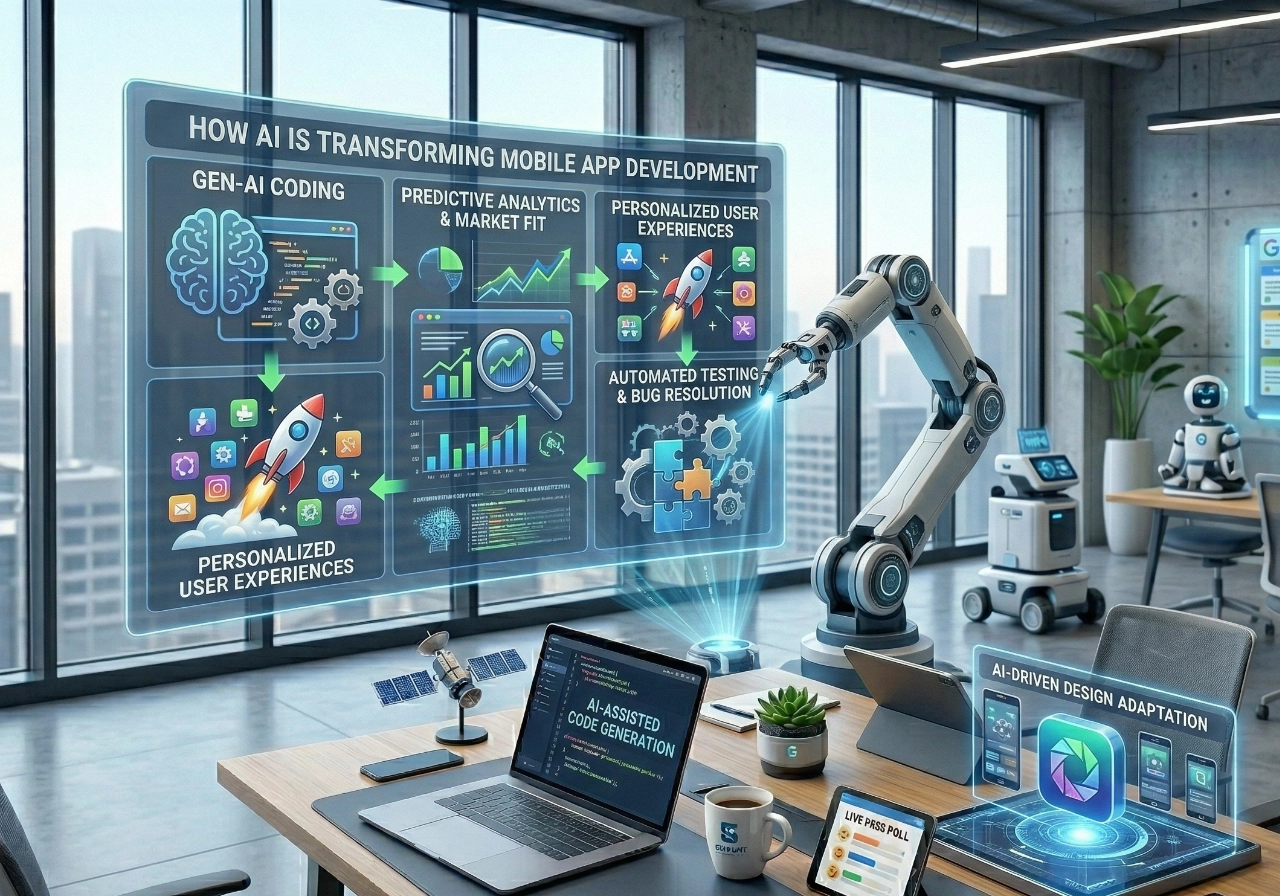
Artificial intelligence is fundamentally reshaping how mobile applications are conceived, designed, built, tested, and maintained. What once required months of manual effort can now be accomplished in weeks with AI assistance. Tasks that demanded specialized expertise are becoming accessible to broader development teams through intelligent automation.
The transformation extends beyond simply building apps faster—AI is changing what’s possible, who can build apps, and how development teams work together. From code generation and automated testing to intelligent design systems and predictive analytics, AI tools are becoming indispensable partners in the development process. Let’s explore how AI is revolutionizing every stage of mobile app development and what this means for businesses, developers, and the future of app creation.
AI-Assisted Code Generation and Development
The most visible AI transformation in app development comes through intelligent code generation tools that accelerate development while improving code quality. GitHub Copilot, Amazon CodeWhisperer, and specialized tools like Cursor have become standard in development workflows, functioning as AI pair programmers that suggest code completions, generate entire functions, and even explain complex code in natural language.
These AI coding assistants understand context across entire codebases, suggesting not just syntactically correct code but implementations consistent with your project’s patterns, style, and architecture. When you start writing a function, the AI predicts your intent and suggests complete implementations. When you write comments describing desired functionality, AI generates working code matching your specifications.
The productivity gains are substantial. Developers report 30-50% faster coding for routine tasks, with AI handling boilerplate code, standard implementations, and repetitive patterns. This frees developers to focus on complex logic, architecture decisions, and creative problem-solving where human judgment remains essential. Junior developers benefit enormously, learning from AI-generated examples and receiving instant guidance on best practices.
Beyond code completion, AI tools help developers work in unfamiliar languages or frameworks. Building a mobile app feature in Swift when you primarily know JavaScript? AI assists with syntax, common patterns, and platform-specific idioms, flattening the learning curve. This enables smaller teams to work across broader technology stacks without requiring specialists in every language.
Code explanation and documentation generation transform legacy code maintenance. Point AI at confusing code blocks and receive plain-language explanations of what the code does and why. Generate comprehensive documentation from existing codebases automatically. These capabilities particularly benefit teams inheriting code from departed developers or maintaining older applications lacking proper documentation.
However, AI coding assistants aren’t infallible. They sometimes suggest insecure code, deprecated APIs, or incorrect implementations that superficially seem correct. Developers must review AI-generated code critically, understanding what it does rather than blindly accepting suggestions. The tools augment human developers rather than replacing them—the human provides judgment, creativity, and quality control while AI handles mechanical coding tasks.
Intelligent Design and UI/UX Creation
AI is revolutionizing the design phase through tools that generate designs, suggest improvements, and automate repetitive design work. AI design assistants analyze user research data to inform design decisions, generate design variations for testing, and ensure accessibility compliance automatically.
Generative design tools create multiple design variations from high-level specifications. Describe your desired app screen—”e-commerce product page with large image, price, add to cart button, and review summary”—and AI generates multiple design options reflecting different aesthetic approaches. Designers review these options, selecting and refining the most promising directions rather than starting from blank canvases.
AI-powered design systems maintain consistency across large applications. Tools analyze existing designs to extract patterns, colors, typography, and spacing rules, codifying them into design systems ensuring consistency. As apps grow and multiple designers contribute, AI-enforced design systems prevent inconsistency that degrades user experience.
Accessibility checking becomes automated and comprehensive through AI analysis of designs and implementations. AI identifies insufficient color contrast, missing alternative text, problematic touch target sizes, or navigation issues before development begins. This proactive accessibility improvement proves far more efficient than retrofitting accessibility after development completes.
A/B testing and design optimization leverage AI to predict which design variations will perform best before expensive user testing. Machine learning models trained on thousands of design experiments predict how layout changes, color choices, or content arrangements will impact conversion rates, engagement, or other key metrics. This predictive capability focuses testing on genuinely promising variations rather than shooting in the dark.
Responsive design optimization uses AI to generate optimal layouts for different screen sizes automatically. Rather than manually designing tablet and phone versions separately, AI understands design intent and creates appropriate adaptations maintaining design integrity across devices. This dramatically reduces design effort for multi-device applications.
Automated Testing and Quality Assurance
Testing represents one of app development’s most time-consuming yet critical aspects. AI is transforming QA through automated test generation, intelligent bug detection, and predictive quality analytics that identify issues before they reach production.
Automated test generation analyzes your application and creates comprehensive test suites covering functionality, edge cases, and integration points. AI understands your app’s behavior and generates tests ensuring new code doesn’t break existing functionality. This automated test creation eliminates the tedious manual work of writing hundreds of test cases.
Visual regression testing using AI detects unintended UI changes across app versions. When you update code, AI compares screenshots of every screen against baseline versions, flagging visual differences for review. This catches layout breaks, styling issues, or component changes that might escape manual testing, ensuring consistent user experiences across updates.
Intelligent bug prediction identifies code likely to contain defects based on complexity metrics, change frequency, and patterns learned from historical bugs. AI flags high-risk code sections for extra testing attention before they cause production issues. This predictive approach prevents bugs rather than just finding them.
Performance testing automation uses AI to simulate realistic user loads and usage patterns, identifying performance bottlenecks, memory leaks, or scaling issues. Rather than manually creating test scenarios, AI generates diverse usage patterns reflecting real-world behavior, uncovering problems manual testing might miss.
Crash analysis and debugging assistance accelerate issue resolution. When apps crash, AI analyzes crash reports, identifies root causes, and even suggests fixes based on similar issues in your codebase or across vast databases of solved problems. What might take hours of debugging can be resolved in minutes with AI assistance.
Test maintenance remains a challenge in traditional automation—tests break when UI changes, requiring constant maintenance. AI-powered testing tools adapt to UI changes automatically, updating selectors and test logic when interfaces evolve. This self-healing capability dramatically reduces test maintenance burden.
AI-Powered Project Management and Estimation
Project management and accurate time estimation perpetually challenge development teams. AI is bringing data-driven precision to scheduling, resource allocation, and risk management.
Intelligent project estimation analyzes project requirements and predicts development timelines based on historical data from thousands of similar projects. Rather than relying purely on developer estimates (notoriously optimistic), AI provides realistic timelines considering complexity, team capabilities, and common challenges specific to your project type.
Resource allocation optimization uses AI to match tasks with team members based on skills, availability, current workload, and learning objectives. The system ensures work distribution prevents burnout while developing team capabilities through strategic task assignments that stretch skills appropriately.
Risk prediction identifies potential project risks—scope creep, technical blockers, resource constraints—before they materialize. AI analyzes project patterns predicting which efforts will encounter difficulties, enabling proactive mitigation rather than reactive crisis management.
Sprint planning assistance recommends optimal story selection for development sprints based on dependencies, complexity, team capacity, and strategic priorities. AI helps teams balance quick wins with long-term architectural work, ensuring sustainable development velocity.
Progress tracking and anomaly detection alerts managers when projects deviate from expected patterns. If development velocity drops unexpectedly or if certain features consistently overrun estimates, AI flags these anomalies for investigation. Early warning enables course correction before minor issues become major delays.
Intelligent Backend Services and Infrastructure
AI is transforming backend development and infrastructure management, making sophisticated backend capabilities accessible without extensive expertise.
Automated API generation creates backend APIs from database schemas or high-level specifications. Describe your data models and business rules, and AI generates complete APIs with proper authentication, validation, documentation, and testing. This democratizes backend development, enabling frontend developers to create full-stack applications.
Database optimization uses AI to analyze query patterns, suggest index improvements, identify inefficient queries, and recommend schema optimizations. Rather than requiring database expertise, developers receive intelligent recommendations keeping their databases performant as data grows.
Security vulnerability detection becomes continuous and comprehensive through AI analysis of code, dependencies, and configurations. AI identifies security issues—SQL injection risks, insecure authentication, exposed secrets, vulnerable dependencies—throughout the development lifecycle rather than only during dedicated security audits.
Infrastructure optimization and cost management leverage AI to right-size cloud resources, identify underutilized services, and recommend architectural changes reducing costs while maintaining performance. For startups and businesses managing cloud costs, AI-powered optimization delivers substantial savings.
Automated incident response and troubleshooting analyze logs, metrics, and traces when issues occur, identifying root causes and suggesting remediation steps. AI correlates data across complex distributed systems, pinpointing problems that would take human operators hours to locate.
Natural Language to App Generation
The most ambitious AI transformation involves generating entire applications from natural language descriptions. While not yet replacing professional developers for complex applications, these tools are democratizing app creation for simpler use cases.
Low-code and no-code platforms enhanced with AI allow non-developers to build functional applications through conversational interfaces. Users describe desired functionality in plain language; AI translates these descriptions into working applications with appropriate UI, logic, and data structures.
Prototyping and MVP development accelerates dramatically when AI can generate working prototypes from product descriptions. Rather than spending weeks building throwaway prototypes, product teams can iterate through multiple concepts rapidly, testing ideas with real users before committing to full development.
Template customization becomes more intelligent as AI understands customization requirements and adapts templates accordingly. Rather than manually modifying every aspect of a template, describe desired changes and AI implements them systematically across the application.
However, limitations remain significant. AI-generated applications work well for standard use cases with common features but struggle with novel functionality, complex business logic, or sophisticated user experiences. For businesses needing custom applications with competitive differentiation, AI tools augment but don’t replace professional developers.
The real value of natural language app generation lies in rapid prototyping, internal tools creation, and enabling business users to build simple applications for their specific needs without IT department involvement. This shifts developer time from routine internal tools to revenue-generating customer-facing applications.
Personalization and User Experience Optimization
AI enables sophisticated personalization and continuous UX optimization that was previously impossible or prohibitively expensive.
Dynamic UI adaptation adjusts interfaces based on user behavior, preferences, and context. Frequent users might see streamlined interfaces hiding tutorials and explanations. New users receive additional guidance and feature discovery. AI determines which interface variations serve each user best.
Behavioral analytics powered by AI identify user friction points, confusion, and abandonment causes. Rather than requiring manual analysis of user session recordings, AI processes thousands of sessions automatically, highlighting where users struggle and suggesting improvements.
Conversion rate optimization becomes continuous as AI tests variations, analyzes results, and implements winning changes automatically. Rather than manual A/B testing requiring weeks to reach statistical significance, AI rapidly cycles through optimizations, compounding improvements over time.
Predictive personalization anticipates user needs before explicit actions. If AI predicts a user will search for specific content based on their history and current behavior, it surfaces that content proactively. This anticipatory design creates delightful experiences that feel almost magical.
Challenges and Considerations
While AI transforms development positively, challenges require thoughtful management. Over-reliance on AI-generated code without understanding can introduce technical debt, security vulnerabilities, or architectural problems. Developers must maintain critical thinking and code review discipline.
Data privacy and security become more complex when AI tools process codebases, user data, or business logic. Ensure AI tools comply with data protection requirements and avoid exposing sensitive information to external AI services inappropriately.
AI bias in training data can perpetuate or amplify biases in generated code, designs, or user experiences. Teams must actively evaluate AI outputs for bias and implement corrections rather than assuming AI objectivity.
Cost management requires attention as AI API calls, training custom models, and AI-powered services add expenses. Monitor AI usage costs and ensure ROI justifies expenses—sometimes simpler non-AI solutions remain more cost-effective.
Skill evolution demands that developers adapt, learning to work effectively with AI tools rather than being replaced by them. Development education must emphasize skills AI can’t replicate—architectural thinking, creative problem-solving, user empathy, and business understanding.
The Future: Collaborative Intelligence
The trajectory points toward deeper human-AI collaboration rather than AI replacement of developers. Future development workflows will seamlessly integrate AI assistance throughout the entire lifecycle, from requirements gathering through deployment and monitoring.
AI won’t replace developers—it will elevate the profession. Developers will spend less time on mechanical coding, debugging, and testing, focusing instead on architecture, user experience, innovation, and business value. The role evolves from code writer to system designer and problem solver.
Businesses benefit from faster development, higher quality, and more innovative solutions as AI handles routine work while humans focus on creating unique value. The democratization of development through AI tools also enables businesses to prototype and build internal tools without full development teams.
The companies that successfully leverage AI in development will move faster, build better products, and innovate more effectively than competitors still working with traditional workflows. This competitive advantage compounds over time, making AI adoption essential rather than optional.
Partner with Experts Who Master AI-Augmented Development
Understanding how AI transforms mobile app development is one thing—successfully leveraging these capabilities to build superior applications faster and more cost-effectively is another. The difference between simply using AI tools and truly mastering AI-augmented development determines whether you capture AI’s full potential or just scratch the surface.
At SolidAppMaker, we don’t just use AI tools—we’ve deeply integrated AI throughout our entire development process. Our team combines traditional software engineering excellence with cutting-edge AI capabilities, delivering applications that would have been impossible or prohibitively expensive just years ago.
When you work with SolidAppMaker, you benefit from:
- Accelerated development timelines through AI-assisted coding, testing, and design
- Higher quality applications from AI-powered testing, security analysis, and code review
- More innovative features leveraging the latest AI capabilities in user-facing functionality
- Cost efficiency as AI automation reduces time spent on routine development tasks
- Future-proof architecture designed to evolve with rapidly advancing AI capabilities
- Strategic AI integration that enhances your app’s competitive position and user experience
We’ve successfully delivered dozens of projects leveraging AI throughout development, from initial concept through deployment and beyond. Our experience spans AI-powered consumer apps, enterprise solutions with intelligent automation, and everything in between.
Ready to build your next mobile app faster, better, and smarter? Schedule a free consultation with the SolidAppMaker team today. We’ll discuss your project, explore how AI can accelerate your development, and provide honest guidance about the best approach for your specific needs and timeline.
Whether you’re starting a new project or modernizing an existing application, AI-augmented development delivers real business advantages: faster time-to-market, reduced development costs, higher quality, and more competitive features. Don’t let competitors gain advantages from AI while you’re still developing the old way.