
The e-commerce landscape has undergone a fundamental transformation in recent years, with headless commerce emerging as a compelling alternative to traditional monolithic platforms. As businesses evaluate their technology stacks for the modern digital marketplace, understanding the trade-offs between these approaches has become critical for strategic planning and competitive positioning.
This comprehensive comparison explores both approaches, helping you determine which architecture aligns best with your business goals and growth trajectory.
Understanding the Fundamental Difference
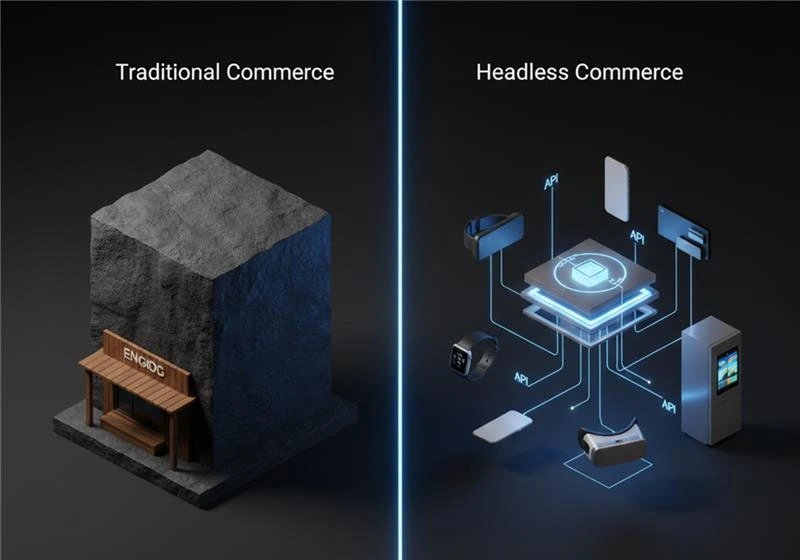
Traditional e-commerce platforms like Shopify, Magento, and BigCommerce provide all-in-one solutions where the frontend presentation layer is tightly coupled with backend commerce functionality. Everything from product catalog management to checkout flows to customer-facing interfaces exists within a single, integrated system. This monolithic architecture has powered countless successful online stores and remains the default choice for many businesses.
Headless commerce takes a fundamentally different approach by decoupling the frontend presentation layer from backend commerce functionality. The commerce engine operates as a pure API, handling product management, inventory, orders, and payments without dictating how customers interact with these capabilities. Frontend experiences can be built using any technology stack, consuming commerce data and functionality through APIs.
This architectural difference creates cascading effects across development workflows, customization capabilities, performance characteristics, and operational considerations. Neither approach is universally superior; the optimal choice depends on your specific business context, technical capabilities, and strategic priorities.
Flexibility and Customization
Flexibility represents one of the most significant advantages of headless commerce. With frontend and backend decoupled, development teams gain complete freedom to craft unique user experiences without platform constraints. You can build custom storefronts using React, Vue, or any other framework, integrate commerce functionality into content-heavy sites, create native mobile apps, or even enable voice commerce through smart speakers, all consuming the same backend commerce APIs.
This flexibility proves particularly valuable for brands where differentiated customer experiences drive competitive advantage. Fashion retailers creating immersive visual experiences, B2B wholesalers building complex ordering workflows, or subscription businesses developing specialized customer portals all benefit from headless architecture’s flexibility. You’re not constrained by what your commerce platform’s theme system allows; if you can build it, you can connect it to your commerce backend.
Traditional platforms offer flexibility within their ecosystems but impose structural limitations. While modern platforms like Shopify provide extensive theme customization and app marketplaces, you’re ultimately working within predefined boundaries. Custom functionality often requires platform-specific plugins or workarounds rather than native implementations. For businesses with standard requirements, these boundaries rarely pose problems. But organizations with unique customer journeys or complex business rules may find traditional platforms restrictive.
The trade-off is complexity. Headless commerce shifts responsibility for the entire frontend experience to your team. Traditional platforms provide battle-tested checkout flows, responsive themes, and accessibility features out of the box. With headless, you build or configure these elements yourself, which offers flexibility but requires expertise and ongoing maintenance.
Development Speed and Time-to-Market
Traditional e-commerce platforms excel at rapid deployment. You can launch a professional online store in days or weeks using pre-built themes, integrated payment processing, and comprehensive admin interfaces. For businesses prioritizing speed-to-market over customization, this represents a significant advantage. The entire infrastructure exists ready-to-use, requiring primarily content population and basic configuration.
This rapid deployment extends to ongoing feature additions. Need product reviews, email marketing, or inventory management? Install apps from the platform marketplace. While this creates some vendor lock-in, it also dramatically reduces development overhead for common functionality. At SolidAppMaker, we’ve launched traditional commerce sites for clients in under a month, complete with professional designs and full functionality.
Headless commerce requires more upfront investment. Building custom frontends takes time, even when using modern frameworks and starter kits. You’re essentially building a custom application that happens to use commerce APIs for backend functionality. Initial deployment timelines typically span months rather than weeks, particularly for organizations without existing headless development expertise.
However, this initial investment pays dividends in long-term development velocity. Once the foundational architecture exists, adding new touchpoints becomes straightforward. Need a mobile app? Build it against the same APIs. Want to integrate commerce into your content marketing site? Connect it to the headless backend. Traditional platforms require separate installations or complex integrations for each new channel.
The optimal choice depends on your timeline and strategic horizon. If you need to launch quickly and iterate within platform boundaries, traditional architecture delivers faster results. If you’re building for multi-channel presence and long-term differentiation, headless architecture’s upfront investment yields compounding returns.
Performance and Scalability
Performance represents a critical competitive advantage in e-commerce. Slow load times directly impact conversion rates, with studies consistently showing that one-second delays reduce conversions by seven percent or more. Both architectural approaches can deliver excellent performance, but through different mechanisms.
Headless commerce offers inherent performance advantages by enabling modern frontend optimization techniques. You can implement server-side rendering, static site generation, edge caching, and progressive web app functionality without platform constraints. Frontends optimized specifically for performance rather than supporting countless features for diverse merchants often deliver superior speed.
The API-first architecture also enables better scalability patterns. Frontend and backend can scale independently based on demand. During traffic spikes, you might scale frontend servers without touching backend infrastructure, or vice versa. This granular scaling improves resource efficiency and cost management for high-traffic operations.
Traditional platforms have made significant performance improvements, leveraging CDNs, optimized themes, and infrastructure investments. Shopify, for example, demonstrates that monolithic platforms can handle enormous scale, supporting merchants processing billions in annual sales. However, you’re sharing infrastructure with other merchants and working within platform performance characteristics.
Performance customization differs between approaches. With headless architecture, every aspect of frontend performance is under your control, allowing surgical optimizations for your specific use case. Traditional platforms offer performance optimization within their frameworks but with less granular control. For most businesses, platform-provided performance proves sufficient. But for operations where milliseconds matter or traffic patterns are unusual, headless provides more optimization leverage.
Cost Considerations
Total cost of ownership extends far beyond platform subscription fees, encompassing development, hosting, maintenance, and opportunity costs of delayed features or constrained experiences.
Traditional platforms typically involve predictable monthly fees based on sales volume or feature tiers, plus transaction fees for payment processing. Development costs remain relatively low for standard implementations, relying on platform tools and marketplace apps. Hosting is included, eliminating infrastructure management. For small to medium businesses with straightforward requirements, this cost structure proves economical and predictable.
However, costs escalate as customization needs increase. Complex customizations require platform-specific expertise, often commanding premium rates. App marketplace subscriptions accumulate quickly, sometimes totaling thousands monthly for larger operations. Transaction fees on platform-managed payment processing, while convenient, represent ongoing percentage costs that scale with success.
Headless commerce shifts the cost structure. Platform fees often decrease since you’re purchasing backend services rather than complete solutions. Commerce platforms like Shopify Plus, BigCommerce Enterprise, and commercetools offer headless APIs, while pure headless providers like Saleor and Medusa provide open-source alternatives. However, frontend development costs increase substantially, requiring either in-house engineering teams or agency partnerships like SolidAppMaker.
Infrastructure costs become explicit with headless architecture. You’re responsible for hosting frontends, managing CDNs, and ensuring uptime. Modern platforms like Vercel and Netlify simplify this considerably, but costs and responsibilities shift from commerce platform to development infrastructure.
The economic calculation depends on scale and complexity. For operations under several million in annual revenue with standard requirements, traditional platforms often prove more economical. Above that threshold, or for businesses with unique requirements, headless architecture’s flexibility often justifies additional costs through superior customer experiences and operational efficiency.
Content and Commerce Integration
The convergence of content and commerce represents a major trend in digital marketing. Customers increasingly expect seamless experiences where editorial content, brand storytelling, and shopping functionality coexist naturally. How architectures handle this integration significantly impacts marketing effectiveness.
Headless architecture excels at content-commerce integration. By treating commerce as APIs rather than destination sites, you can weave shopping functionality throughout content experiences. Blog posts can include embedded product recommendations with native buy buttons. Editorial content can transition seamlessly to product pages. Magazine-style layouts can incorporate shopping functionality organically.
This composable approach where different systems handle their specialties and integrate through APIs enables sophisticated digital experiences. Your CMS handles content, commerce platform manages transactions, personalization engine customizes experiences, and search provider powers discovery, all orchestrated through a custom frontend that presents a unified experience.
Traditional platforms increasingly recognize content importance, adding blogging functionality, page builders, and content management features. Shopify’s enhanced CMS capabilities and BigCommerce’s WordPress integration demonstrate this evolution. However, content functionality remains secondary to commerce, limiting sophistication for content-heavy strategies.
Organizations prioritizing content marketing, editorial commerce, or branded experiences often find headless architecture better supports their vision. Traditional platforms serve businesses where commerce transactions are primary and content supports discovery and conversion rather than driving brand positioning.
Technical Expertise Requirements
The technical skills required to successfully implement and maintain each architecture differ substantially, with significant implications for team building and vendor relationships.
Traditional platforms are explicitly designed for accessibility. Store owners with limited technical knowledge can manage products, process orders, and customize basic storefront elements through intuitive admin interfaces. While advanced customization requires developer expertise, day-to-day operations remain accessible to non-technical teams. This democratization of e-commerce has enabled countless entrepreneurs to build successful online businesses.
Headless commerce demands significantly higher technical sophistication. Someone must build and maintain custom frontends, integrate APIs, manage deployment pipelines, and handle ongoing infrastructure. This typically requires dedicated engineering teams or partnerships with development agencies. The barrier to entry is substantially higher, limiting headless commerce primarily to organizations with technical resources or budgets to acquire them.
This technical requirement extends beyond initial launch. With traditional platforms, updates and security patches are managed by platform providers. With headless architecture, you’re responsible for maintaining frontend code, updating dependencies, and ensuring security across your entire stack. This operational burden requires ongoing engineering investment.
However, this responsibility also provides control. You’re not dependent on platform release cycles for bug fixes or feature updates. You can adopt new technologies immediately rather than waiting for platform support. For organizations with strong technical teams, this control outweighs the additional responsibility.
Multi-Channel and International Expansion
Expanding into new channels or geographic markets represents a common growth trajectory, and architectural choices significantly impact expansion ease and effectiveness.
Headless commerce simplifies multi-channel strategies. The same commerce backend powers websites, mobile apps, in-store kiosks, voice assistants, or any other customer touchpoint. Each channel can optimize its interface for specific contexts and constraints while sharing product catalogs, inventory, and customer data. This consistency across channels improves operational efficiency while allowing channel-specific optimizations.
International expansion benefits from headless flexibility. You can build region-specific frontends addressing local preferences, languages, and payment methods while sharing core commerce functionality. Different teams can iterate on regional experiences independently without impacting other markets.
Traditional platforms have evolved multi-channel capabilities, offering POS integrations, mobile app solutions, and marketplace connections. International features including multi-currency support and localization tools are increasingly standard. However, each channel typically operates somewhat independently, requiring separate configurations and potentially fragmenting customer data.
The practical difference depends on expansion ambitions. For businesses focused primarily on web commerce in limited markets, traditional platforms provide sufficient multi-channel and international capabilities. Organizations pursuing aggressive expansion across diverse channels and geographies benefit from headless architecture’s composable approach.
Making the Right Choice for Your Business
Neither architecture is universally superior. The optimal choice depends on evaluating your specific circumstances against several key dimensions.
Choose traditional e-commerce if you need rapid deployment, have limited technical resources, require predictable operational costs, operate primarily through web channels, or have standard commerce requirements well-served by platform capabilities. Traditional platforms have matured substantially, powering businesses from startups to enterprises effectively.
Choose headless commerce if you require highly differentiated customer experiences, plan expansion across multiple channels, have complex business logic not well-served by platforms, possess or can access strong technical capabilities, or need architectural flexibility as a competitive advantage. The additional complexity and cost are investments in long-term flexibility and differentiation.
Many businesses adopt hybrid approaches, using traditional platforms with headless capabilities through their APIs, or implementing headless architecture for customer-facing experiences while using traditional platforms for back-office operations. This pragmatic middle ground balances flexibility with operational practicality.
At SolidAppMaker, we guide clients through these architectural decisions based on business objectives rather than technical preferences. We’ve seen businesses thrive with both approaches when architecture aligns with strategy, team capabilities, and market positioning. The worst outcome is choosing an architecture that sounds exciting but mismatches your operational reality.
Conclusion
The headless versus traditional commerce debate represents a broader shift in how businesses approach digital experiences. Traditional platforms prioritize convenience, integration, and rapid deployment. Headless commerce prioritizes flexibility, customization, and architectural control. Both approaches enable successful e-commerce operations when properly implemented and maintained.
As you evaluate architectures for your business, focus on strategic alignment rather than technical trends. Consider your timeline, budget, team capabilities, differentiation requirements, and growth plans. The right architecture today may differ from the right architecture in three years, and that’s acceptable. Many businesses successfully migrate between approaches as their needs evolve.
What matters most is delivering excellent customer experiences that drive business results. Whether you achieve that through traditional platforms, headless architecture, or hybrid approaches is ultimately less important than executing well on whichever path you choose. With careful evaluation and expert implementation, either architecture can power exceptional e-commerce operations that delight customers and drive sustainable growth.