
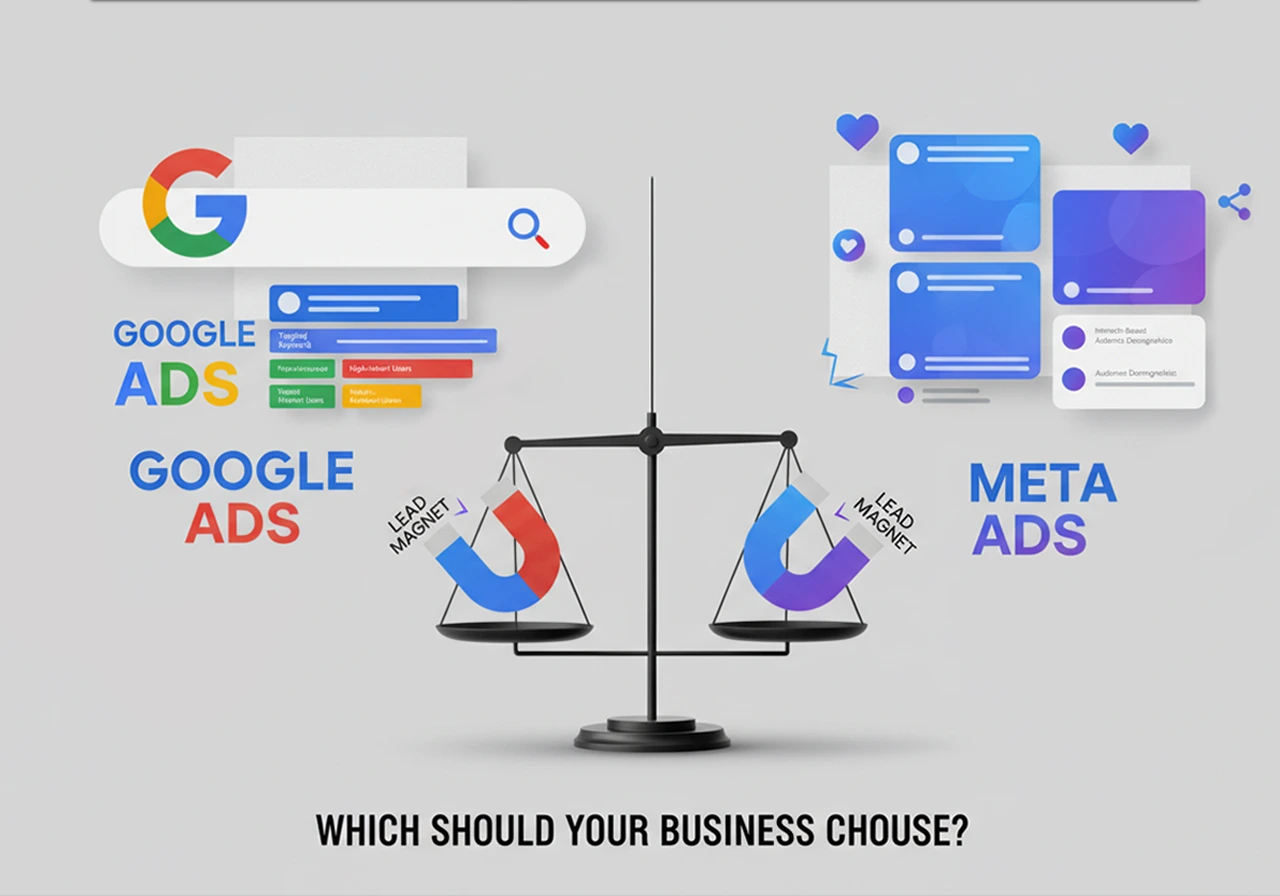
Choosing between Google Ads and Meta Ads (Facebook and Instagram) represents one of the most critical decisions in your digital advertising strategy. Both platforms offer powerful lead generation capabilities, but they operate on fundamentally different principles, target users in distinct mindsets, and excel in different scenarios. Understanding these differences—and how they align with your business model, target audience, and goals—determines whether your advertising budget generates qualified leads or disappears without returns. Let’s dive deep into both platforms to help you make the right choice for your business.
Understanding the Fundamental Difference: Intent vs. Interest
The core distinction between Google Ads and Meta Ads lies in user intent versus user interest. Google Ads operates on a pull marketing model, capturing users actively searching for solutions to their problems. When someone searches “CRM software for small business,” they’re demonstrating clear intent to find and evaluate CRM solutions right now. This active intent typically translates to higher conversion rates and more qualified leads, though often at higher costs per click.
Meta Ads employs a push marketing model, displaying ads to users based on their demographics, interests, behaviors, and connections while they’re browsing social feeds. These users aren’t actively searching for your solution—you’re interrupting their social media experience with relevant messaging. This interruption-based model requires more persuasive creative and often longer nurture cycles, but it allows you to reach prospects before they’re actively shopping, potentially capturing them earlier in the buyer journey.
This intent versus interest dynamic shapes everything else about how these platforms work. Google Ads excels at capturing demand that already exists, while Meta Ads excels at creating awareness and generating demand. Neither approach is inherently superior—the right choice depends entirely on your specific business context, offer, and customer acquisition strategy.
Audience Targeting: Precision vs. Discovery
Google Ads targeting revolves primarily around keywords—the actual search terms users type into Google. This keyword-based targeting provides incredible precision for capturing specific intent. You can target users searching for exactly what you offer, down to very specific product features, use cases, or even competitor names. Audience targeting options exist through remarketing, customer match, and in-market audiences, but keywords remain the primary targeting mechanism for search campaigns.
Meta Ads offers extraordinarily detailed demographic and psychographic targeting. You can target users by age, gender, location, language, education level, job title, interests, behaviors, life events, and connections. Custom audiences let you target website visitors, email subscribers, or app users. Lookalike audiences identify new prospects who share characteristics with your best customers. This granular targeting enables you to reach very specific audience segments, even if they’re not currently searching for your solution.
The targeting philosophy differs fundamentally: Google asks “what are people searching for?” while Meta asks “who are the people we want to reach?” For products or services with clear search demand, Google’s keyword targeting captures high-intent prospects efficiently. For newer products, niche offerings without established search volume, or situations where you need to educate prospects about problems they don’t yet realize they have, Meta’s detailed audience targeting creates opportunities to build awareness and generate interest.
Ad Formats and Creative Requirements
Google Search Ads are text-based, consisting of headlines, descriptions, and extensions. These ads appear directly in search results, making them highly contextual but limiting creative expression. Your messaging must be concise and compelling within character limits: 30 characters per headline, 90 characters per description. Success depends on copywriting excellence—communicating value propositions, differentiation, and calls-to-action within tight constraints.
Google Display Network expands creative possibilities with image and video ads appearing on millions of websites. Display ads work well for remarketing and awareness campaigns but typically generate lower-quality leads than search ads. YouTube ads, also part of Google Ads, offer video advertising opportunities with multiple formats from skippable in-stream ads to discovery ads.
Meta Ads emphasizes visual storytelling through images, videos, carousels, and collections. The social context demands scroll-stopping creative that captures attention in crowded feeds. Successful Meta ads often use lifestyle imagery, user-generated content, testimonials, or demonstration videos that showcase products in authentic contexts. You have more creative flexibility than Google text ads but face higher creative production demands.
Lead form ads on Meta allow users to submit contact information without leaving the platform, reducing friction significantly. These native lead forms come pre-populated with information from users’ Facebook profiles, making submission nearly effortless. Google offers similar lead form extensions, but Meta’s implementation typically performs better for pure lead capture due to platform context and user behavior.
Cost Structures and Budget Considerations
Cost per click typically runs higher on Google Ads, particularly for competitive commercial keywords. CPCs in industries like legal services, insurance, or B2B software can reach $50-$150 per click or higher. However, these expensive clicks often come from users with strong purchase intent, potentially justifying higher acquisition costs through superior conversion rates and customer lifetime value.
Meta Ads generally offers lower cost per click, with CPCs often ranging from $0.50-$5.00 depending on targeting and industry. The tradeoff is that these cheaper clicks come from users who weren’t actively searching for your solution, potentially requiring more touches and longer nurture cycles before conversion. Your cost per lead might be lower initially, but cost per qualified lead or cost per customer might tell a different story.
Budget flexibility differs between platforms. Meta Ads typically works with smaller budgets—you can test campaigns meaningfully with $10-$20 per day. Google Ads, especially for competitive keywords, often requires larger budgets to generate sufficient data. If you’re bidding $15 per click, a $10 daily budget yields less than one click per day, insufficient for meaningful testing or optimization.
The learning phase also affects budget requirements. Both platforms use machine learning to optimize delivery, but they need data to learn effectively. Meta’s algorithm typically requires 50 conversions per ad set per week to exit the learning phase and optimize effectively. Google’s automated bidding strategies similarly need conversion volume. Insufficient budget prevents algorithms from gathering enough data, limiting performance.
Lead Quality and Conversion Considerations
Lead quality often favors Google Ads because search intent indicates active interest and near-term purchase consideration. Someone searching “hire React developer” is likely evaluating options now, not researching casually. These high-intent leads typically have shorter sales cycles and higher close rates, though they cost more to acquire upfront.
Meta Ads leads can be lower quality initially because users didn’t actively seek your solution. They might have clicked out of curiosity, slight interest, or even by accident while scrolling. However, this doesn’t mean Meta leads are inherently inferior—it means they’re often earlier in the buyer journey and require different nurture approaches. With proper lead scoring, nurture sequences, and patience, Meta leads can deliver excellent ROI.
Lead form quality on Meta requires particular attention. The ease of submitting native lead forms creates friction-free conversions but sometimes generates low-quality leads from users who submit casually without serious intent. Combat this by adding qualifying questions to your forms, setting clear expectations about next steps, and implementing robust lead scoring to prioritize follow-up.
Conversion tracking complexity differs between platforms. Google Ads conversion tracking integrates directly with your website, tracking form submissions, purchases, or custom events with straightforward implementation. Meta’s conversion tracking requires the Meta Pixel, which faces increasing challenges from iOS privacy features and cookie restrictions. Meta’s Conversions API provides more reliable tracking but requires technical implementation.
Sales Cycle and Customer Journey Alignment
Short sales cycles with clear purchase intent favor Google Ads. If customers typically research and purchase within days or weeks, capturing them at the moment of active search delivers efficient conversions. E-commerce, local services, urgent needs, and transactional B2B sales often fit this profile. The high cost per click justifies itself through rapid conversion and immediate revenue.
Long sales cycles with extended consideration periods often benefit from Meta Ads’ ability to build awareness and nurture prospects over time. Complex B2B sales, high-consideration purchases, innovative products requiring education, or lifestyle changes typically involve months-long decision processes. Meta Ads allows you to reach prospects early, build familiarity through remarketing, and stay visible throughout their journey.
Multi-touch attribution becomes critical for longer sales cycles. Prospects might first discover you through Meta Ads, later search for your brand on Google, visit your website multiple times, and eventually convert. Understanding how different touchpoints contribute to conversions prevents you from undervaluing top-of-funnel awareness efforts that initiate journeys ultimately completed through direct or branded search.
Remarketing strategies differ between platforms. Google remarketing excels at recapturing people who visited your website but didn’t convert, showing them ads as they search or browse the web later. Meta remarketing leverages social proof and social context, potentially showing ads endorsed by friends or featuring user testimonials. Both are effective but work through different psychological mechanisms.
Industry and Audience Considerations
B2B lead generation often performs exceptionally well on both platforms but in different ways. Google Ads captures prospects actively searching for B2B solutions, ideal for established categories with clear search demand. LinkedIn (owned by Microsoft but often compared with Meta for B2B social advertising) offers superior professional targeting, but Meta can work well for small business owners and entrepreneurs who aren’t active on LinkedIn.
Local businesses generating leads for services like plumbing, landscaping, or home improvement typically see excellent results from Google Ads, especially with local service ads and location extensions. Customers with urgent needs search immediately, making high-intent search advertising ideal. Meta can work for local businesses building awareness and community connections but typically serves supplementary rather than primary roles.
E-commerce and direct-to-consumer brands often excel on Meta due to visual product showcase opportunities and demographic targeting precision. Fashion, beauty, home goods, and lifestyle products benefit from Meta’s visual formats and interest-based targeting. Google Shopping ads also perform well for e-commerce, making multi-platform strategies common in this sector.
Age demographics influence platform choice significantly. Younger audiences spend more time on Instagram and TikTok (though TikTok ads operate separately from Meta), while older demographics may respond better to Facebook or Google. Understanding where your specific target audience spends time and how they research solutions informs platform selection.
Testing, Optimization, and Scaling
Google Ads optimization centers on keyword refinement, Quality Score improvement, and bid management. Success requires continuous negative keyword discovery, search query mining, and landing page optimization. The feedback loop between search queries and performance data creates clear optimization paths—you can see exactly which searches generate leads and adjust accordingly.
Meta Ads optimization focuses on creative testing, audience refinement, and funnel optimization. Creative fatigue—declining performance as audiences repeatedly see the same ads—necessitates regular creative refresh. Audience testing helps identify which demographic and interest segments respond best. The optimization process is less transparent than Google because you don’t see exactly why Meta chose to show your ad to specific users.
Scaling challenges differ between platforms. Google Ads scaling is limited by search volume—only so many people search for your keywords each month. Increasing budgets beyond available search volume doesn’t generate more leads, it just raises costs. Meta Ads scaling faces creative fatigue and audience saturation but isn’t limited by search volume. You can potentially reach massive audiences if you have compelling creative and attractive offers.
Data and analytics maturity affects platform choice. Google Ads provides detailed search query reports, keyword performance data, and conversion paths. This transparency enables data-driven optimization even with moderate analytical sophistication. Meta Ads requires more sophisticated analysis to understand performance because you can’t see exactly why people saw your ads or what specifically drove conversions.
Making Your Platform Decision
Choose Google Ads as your primary platform when you have clear search demand for your offering, need to capture high-intent prospects actively shopping, operate in industries with established search behavior, want shorter sales cycles and faster ROI, or have higher budgets that can accommodate premium CPCs. Google excels at converting existing demand efficiently.
Choose Meta Ads as your primary platform when you’re introducing innovative products without established search demand, need to build awareness and educate prospects, target very specific demographic or psychographic audiences, operate with smaller budgets requiring efficient testing, or have longer sales cycles that benefit from early awareness. Meta excels at generating new demand and reaching prospects before they’re actively shopping.
The reality for most businesses is that both platforms play valuable roles in comprehensive lead generation strategies. Google captures prospects when they’re ready to buy, while Meta builds awareness and nurtures prospects before they reach active consideration. This complementary relationship means the question often isn’t “which platform?” but rather “how should I allocate budget between platforms?”
Building an Integrated Approach
Start with platform strength alignment—use each platform for what it does best. Run Google Ads for your highest-intent keywords capturing active shoppers, while using Meta Ads to build awareness, generate interest, and reach prospects earlier in their journeys. This creates a complete funnel covering both demand capture and demand generation.
Implement cross-platform remarketing that leverages both ecosystems. Use Meta to remarket to people who clicked Google Ads but didn’t convert, showing them social proof and testimonials. Use Google to capture branded searches from people who discovered you through Meta Ads. This coordinated approach maximizes the value of every prospect who enters your ecosystem regardless of entry point.
Budget allocation should be dynamic based on performance data and business goals. During growth phases, allocate more to Meta for awareness and audience building. During revenue-focused periods, shift toward Google to maximize conversion of existing demand. Track full-funnel metrics including first-touch attribution to understand how platforms work together rather than evaluating them solely on last-click conversions.
The Path Forward
Neither Google Ads nor Meta Ads is universally superior—they’re different tools serving different purposes. Your ideal choice depends on your specific business model, target audience behavior, competitive landscape, budget constraints, and growth objectives.
We (at Solid App Maker), have helped businesses succeed with both platforms and with integrated strategies that leverage the unique strengths of each. Start by clearly defining your customer acquisition goals, understanding your audience’s research behavior, and honestly assessing your budget and resources. Test both platforms if possible, measuring not just cost per lead but cost per qualified lead and ultimately cost per customer. The insights from real performance data in your specific market will guide you toward the optimal strategy—whether that’s focusing on one platform or building a sophisticated multi-platform approach that captures prospects throughout their entire buying journey.