
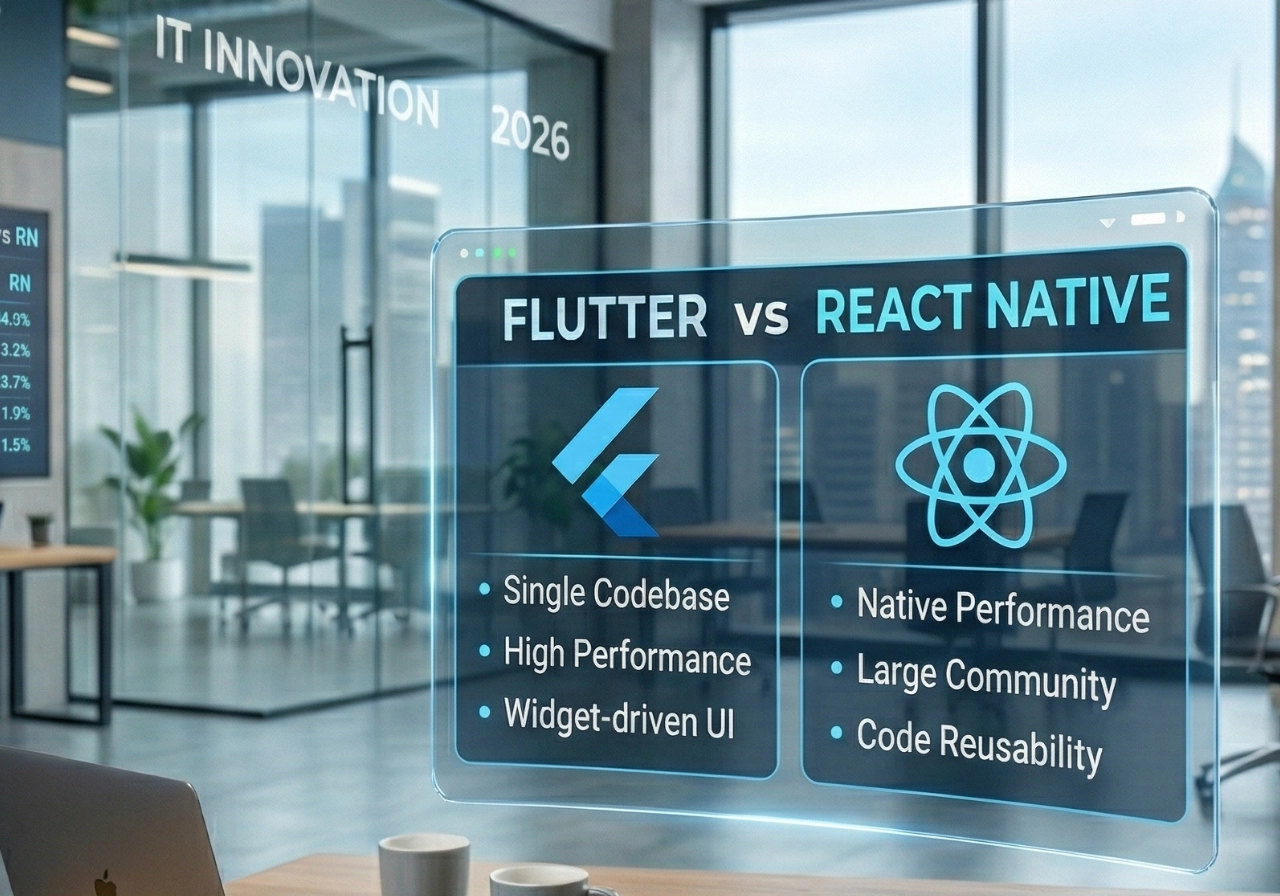
For startups building mobile applications, choosing the right cross-platform framework can make the difference between rapid market entry and costly delays, between efficient resource utilization and budget overruns. Flutter and React Native have emerged as the dominant players in cross-platform mobile development, each with passionate advocates and proven track records powering apps used by millions.
But which framework should your startup choose? The answer isn’t universal—it depends on your team’s skills, timeline constraints, feature requirements, and long-term vision. Let’s dive deep into both frameworks, examining their strengths, weaknesses, and ideal use cases to help you make the informed decision that sets your startup up for success.
Understanding the Fundamental Differences
React Native, released by Meta (formerly Facebook) in 2015, revolutionized mobile development by allowing developers to build iOS and Android apps using JavaScript and React. It uses a bridge to communicate between JavaScript code and native platform components, rendering actual native UI elements. This architecture means React Native apps feel genuinely native because they use the same fundamental UI building blocks as native apps.
Flutter, launched by Google in 2017, takes a different approach. Built with the Dart programming language, Flutter includes its own rendering engine that draws every pixel on the screen. Rather than using platform-native components, Flutter provides its own comprehensive widget library that looks and behaves consistently across platforms. This fundamental architectural difference shapes everything else about how these frameworks work and perform.
The bridge versus rendering engine distinction has profound implications. React Native’s bridge architecture provides direct access to native components but introduces potential performance bottlenecks when communicating between JavaScript and native code. Flutter’s rendering approach delivers consistent performance and pixel-perfect design control but requires the framework’s rendering engine to be included in your app bundle, increasing initial app size.
For startups, these architectural differences translate to practical considerations around development speed, app performance, design flexibility, and team requirements. Neither approach is inherently superior—the right choice depends on your specific context, priorities, and constraints.
Developer Experience and Learning Curve
React Native offers tremendous advantages for teams with existing JavaScript and React expertise. If your startup has web developers familiar with React, they can transition to mobile development with minimal learning curve. The concepts, patterns, and even many libraries they already know transfer directly. This dramatically reduces hiring costs and onboarding time—your existing team can start building mobile apps immediately.
JavaScript’s ubiquity means an enormous talent pool. Finding React Native developers is relatively easy compared to more specialized frameworks. Freelance platforms, job boards, and development agencies all have abundant React Native expertise. For resource-constrained startups, this accessibility matters enormously. You won’t struggle to find developers when you need to scale your team or replace departing members.
Flutter requires learning Dart, a language with significantly smaller adoption than JavaScript. While Dart is well-designed and relatively easy to learn—especially for developers familiar with Java, C#, or JavaScript—it represents an additional learning investment. For teams without existing Dart experience, expect 2-4 weeks of reduced productivity as developers familiarize themselves with the language and framework.
However, Flutter’s learning curve, while initially steeper, leads to excellent developer experience once overcome. Developers frequently praise Flutter’s hot reload, comprehensive documentation, and cohesive ecosystem. The framework’s widget-centric approach and strong typing through Dart create satisfying development experiences with fewer runtime surprises than JavaScript’s looser typing.
For startups, the learning curve consideration depends heavily on your current team composition and hiring strategy. If you have web developers you want to leverage immediately, React Native’s JavaScript foundation provides faster time-to-productivity. If you’re hiring specifically for mobile development or have team members willing to invest in learning, Flutter’s excellent developer experience might justify the initial investment.
Performance Characteristics
Performance matters for user experience, app store ratings, and ultimately business success. Both frameworks deliver acceptable performance for most applications, but differences emerge in specific scenarios that might matter for your startup’s particular app.
Flutter generally delivers more consistent, predictable performance because its rendering engine doesn’t depend on a bridge to communicate with native code. Animations in Flutter are smooth and performant by default, running at 60fps or 120fps on capable devices. The framework’s architecture eliminates the bridge communication overhead that can cause jank in React Native apps during complex UI updates or rapid state changes.
React Native performance has improved dramatically, especially with the New Architecture released in recent years. The new architecture eliminates the bridge, implementing direct communication between JavaScript and native code through JavaScript Interface (JSI) and Fabric for rendering. Apps using the New Architecture achieve performance much closer to Flutter and native apps. However, not all libraries support the New Architecture yet, potentially limiting its immediate benefits.
For computationally intensive apps—games, complex animations, real-time data visualization, or image processing—Flutter’s consistent performance characteristics provide advantages. The framework handles complex UIs with many simultaneous animations more gracefully than React Native’s bridge architecture.
However, for typical business applications—social networks, e-commerce, content delivery, booking systems—both frameworks deliver perfectly acceptable performance. Most users won’t notice performance differences in these scenarios. Your choice should be driven by other factors unless you’re building specifically performance-critical applications.
Startup applications rarely need absolute maximum performance initially. You’re validating product-market fit, iterating based on user feedback, and building toward scalability. Both frameworks support successful apps with millions of users. Performance optimization becomes relevant as you scale, and both frameworks provide optimization paths when needed.
User Interface and Design Flexibility
Flutter excels at custom, highly-polished user interfaces with pixel-perfect design implementation. Because Flutter draws every pixel, designers have complete control over every visual aspect. Complex custom animations, brand-specific design languages, and unique UI patterns are all achievable without fighting against platform conventions. Apps like Google Pay, BMW, and Alibaba leverage Flutter precisely for this design flexibility.
The framework includes Material Design and Cupertino (iOS-style) widget libraries out of the box, allowing you to build apps that look native on each platform or maintain consistent cross-platform designs. This flexibility lets startups choose whether to embrace platform conventions or establish distinctive branded experiences that look identical on iOS and Android.
React Native renders platform-native components, meaning iOS and Android versions of your app automatically adopt platform-specific look and feel. This provides native appearance with minimal effort but makes achieving identical cross-platform designs more challenging. If you want your app to look exactly the same on both platforms, you’ll need custom components or third-party libraries, adding complexity.
For startups, the UI consideration depends on your brand and design priorities. If you want apps that feel native to each platform with minimal design effort, React Native’s native component rendering saves time. If you’re building a strong brand identity requiring specific visual language across all touchpoints, Flutter’s design control delivers better results.
Consider your design team’s capabilities and preferences. Designers working with Flutter can translate their visions directly to implemented apps with precise control. Designers working with React Native need to understand platform conventions and design within those constraints or invest in custom component development.
Ecosystem and Third-Party Libraries
React Native benefits from JavaScript’s massive ecosystem and years of maturity. NPM hosts hundreds of thousands of packages, many working directly in React Native or requiring minimal adaptation. Need authentication? Payment processing? Analytics? Social sharing? Libraries exist for virtually everything. This extensive ecosystem accelerates development by providing pre-built solutions for common needs.
However, React Native’s ecosystem fragmentation presents challenges. Libraries vary in quality, maintenance status, and platform support. Some libraries work perfectly on iOS but have issues on Android, or vice versa. Evaluating library quality, checking maintenance activity, and verifying cross-platform support becomes necessary due diligence that adds time to development.
Flutter’s ecosystem, while younger, has matured rapidly. The pub.dev package repository hosts over 50,000 packages covering most common development needs. Google maintains many official packages for Firebase, Google Maps, in-app purchases, and other frequently-needed capabilities. The Flutter team’s official packages generally maintain high quality standards and comprehensive documentation.
Flutter’s smaller but more curated ecosystem means fewer choices but higher average quality. Package discovery is easier because fewer abandoned or low-quality packages clutter search results. However, you might occasionally need features that don’t have mature Flutter packages yet, requiring custom development or wrapping native libraries—possible but time-consuming.
For startups moving quickly, React Native’s mature ecosystem provides more pre-built solutions, potentially accelerating development despite quality variation. Flutter’s growing ecosystem covers most needs with higher average quality but might require occasional custom development for specialized requirements.
Platform Integration and Native Features
React Native was designed for accessing native platform features, with straightforward bridges to native code when needed. Need to implement platform-specific functionality? Writing native modules in Swift/Kotlin and calling them from JavaScript is well-documented and relatively straightforward. This architecture makes React Native excellent for apps requiring deep platform integration or cutting-edge platform features.
The framework’s native module system means early access to new iOS and Android features. When Apple or Google releases new APIs, you can write native bridges immediately rather than waiting for framework updates. This matters for startups building apps leveraging platform-specific capabilities or wanting immediate access to new platform features.
Flutter also supports platform channels for native code integration but with slightly more friction than React Native. The Dart-to-native communication requires more boilerplate, and the community-contributed packages for platform features sometimes lag behind native releases. However, Flutter’s plugin ecosystem covers most common platform integration needs without requiring custom native code.
For typical startup apps using standard platform features—camera, location, notifications, storage—both frameworks provide excellent support through well-maintained packages. Differences emerge only when requiring cutting-edge platform features immediately upon release or deep integration with platform-specific APIs.
Consider your app’s platform integration requirements realistically. Most apps use standard features both frameworks support excellently. Only choose based on platform integration if you’re specifically building apps requiring immediate access to newest platform features or deep platform-specific functionality.
Community Support and Resources
React Native’s larger, more established community provides abundant resources for learning and problem-solving. Stack Overflow has over 100,000 React Native questions answered. Tutorial platforms, YouTube channels, and blogs extensively cover React Native development. When you encounter problems, solutions likely already exist somewhere online.
The community’s maturity also means more third-party tools, development aids, and best practice documentation. React Native development patterns are well-established, with clear guidance on state management, navigation, testing, and other architectural concerns. This accumulated wisdom accelerates development and helps teams avoid common pitfalls.
Flutter’s community, while smaller, is highly engaged and growing rapidly. Stack Overflow has over 150,000 Flutter questions, indicating active community problem-solving. Google’s investment in Flutter includes comprehensive official documentation often praised as superior to React Native’s. The Flutter team actively engages with the community through Discord, GitHub, and regular updates.
Flutter’s official packages and clear architectural guidance from Google create more cohesive development experiences than React Native’s fragmented ecosystem. When Google provides official solutions, they’re typically high-quality and well-maintained, reducing the evaluation burden compared to React Native’s multitude of community options.
For startups, both communities provide adequate support for successful development. React Native’s larger community offers more existing solutions to problems, while Flutter’s engaged community and official guidance provide clarity and quality that can accelerate development despite smaller size.
Testing and Quality Assurance
Flutter includes robust testing capabilities built into the framework from the beginning. Widget testing, integration testing, and unit testing are first-class features with excellent documentation and tooling. The framework’s architecture makes testing straightforward, with clear patterns for mocking dependencies and testing UI components in isolation.
Flutter’s hot reload extends to tests, enabling rapid test-driven development workflows. Developers can write tests and immediately see results without rebuild delays. This tight feedback loop encourages comprehensive testing, improving code quality and reducing bugs reaching production.
React Native testing has matured significantly with tools like Jest for unit testing and React Native Testing Library for component testing. Detox and Appium enable end-to-end testing, though with more setup complexity than Flutter’s integrated testing. The JavaScript testing ecosystem provides powerful tools, though with more fragmentation requiring evaluation and integration effort.
For startups, comprehensive testing matters less initially than rapid iteration and market validation. However, as you gain users and scale, testing prevents regression bugs and enables confident refactoring. Flutter’s integrated testing advantage becomes more valuable as your codebase grows and testing becomes critical for maintaining velocity.
Development Speed and Time-to-Market
React Native often enables faster initial development for teams with JavaScript expertise. Leveraging existing knowledge and the mature package ecosystem allows rapid feature implementation. Startups can build MVPs quickly, test market fit, and iterate based on user feedback without significant learning investment.
Hot reload in both frameworks dramatically accelerates development compared to native development’s compile-wait-test cycles. Changes appear instantly, enabling rapid experimentation and iteration. Both frameworks deliver similar productivity gains over native development, with differences in absolute speed depending more on team expertise than framework characteristics.
Flutter’s widget-centric development and comprehensive widget library can accelerate UI development once teams are proficient. Building complex layouts often requires less code in Flutter than React Native. The framework’s strong typing catches more errors at development time rather than runtime, reducing debugging time.
For startups, time-to-market often matters more than long-term maintainability initially. React Native’s JavaScript foundation provides faster starts for teams with web development backgrounds. Flutter requires initial learning investment but delivers excellent productivity once teams are proficient.
Consider your startup’s specific timeline pressures. If you need an MVP in market within 6-8 weeks and have JavaScript developers, React Native probably gets you there faster. If you have 3-4 months and team members willing to learn, Flutter’s productivity post-learning might deliver better long-term velocity.
Long-Term Maintenance and Scalability
Both frameworks support apps scaling to millions of users with proper architecture. Instagram, Facebook Marketplace, Discord, and Shopify use React Native. Google Pay, Alibaba, BMW, and eBay use Flutter. Framework choice doesn’t limit scalability—architecture and engineering practices matter more.
React Native’s upgrade path has historically been painful, with breaking changes between versions requiring significant migration effort. The community has thousands of discussions about upgrade difficulties. Recent versions have improved stability, but legacy baggage creates some upgrade friction. Budget time for framework updates and their necessary code changes.
Flutter’s younger age means less legacy complexity but also fewer long-term maintenance case studies. Google’s commitment to backward compatibility has been good, with most updates requiring minimal code changes. The framework’s rapid evolution means new capabilities arrive regularly, though sometimes with deprecation of older approaches.
For startups, long-term maintenance matters less initially than rapid development and market validation. However, if your app succeeds, you’ll maintain the codebase for years. React Native’s mature but sometimes challenging upgrade path versus Flutter’s smoother but less proven long-term trajectory represents a tradeoff without clear winners.
Both frameworks have corporate backing ensuring continued development. Meta uses React Native extensively in their apps, while Google uses Flutter across many products. This corporate commitment provides confidence in long-term viability for both frameworks.
Cost Considerations
Development costs with either framework run 30-40% less than building separate native iOS and Android apps. Both frameworks share this fundamental cross-platform cost advantage over native development. Differences in costs between Flutter and React Native relate more to team composition and timeline than framework choice.
React Native might cost less initially if you have JavaScript developers transitioning to mobile. No hiring, no training, immediate productivity. This particularly matters for early-stage startups with limited resources and urgent timelines.
Flutter might require initial training investment but potentially lower long-term maintenance costs through cleaner architecture and fewer platform-specific issues. The framework’s strong typing catches bugs earlier, potentially reducing debugging time and production issues.
Both frameworks have similar tooling costs—they’re open-source with free development tools. Cloud costs, app store fees, and third-party service costs remain identical regardless of framework choice.
For startups, cost optimization matters enormously. Choose the framework letting you leverage existing team skills or minimize new hiring. The savings from using developers you already have or can easily hire typically outweigh subtle framework cost differences.
Making Your Decision: A Framework for Choosing
Choose React Native if you have JavaScript/React developers you want to leverage immediately, need to ship an MVP in 6-8 weeks, want the largest possible talent pool for hiring, require immediate access to cutting-edge platform features, or have complex requirements needing extensive third-party packages from NPM ecosystem.
Choose Flutter if you’re hiring specifically for mobile development, have 3-4 months for learning and development, prioritize consistent cross-platform UI/UX, need complex custom animations and polished design, value integrated testing and strong typing, or want more predictable performance characteristics.
Neither framework limits your startup’s potential success. Instagram has billions of users on React Native. Google Pay handles millions of transactions on Flutter. Framework choice matters less than execution, product-market fit, and user experience.
Consider your specific context: team skills, timeline constraints, design requirements, platform integration needs, and long-term vision. Talk with your development team about their preferences and learning willingness. Prototype simple apps in both frameworks to get hands-on experience before committing.
Real-World Startup Considerations
Your first framework choice isn’t necessarily permanent. Many successful apps have migrated between technologies as their needs evolved. Start with the framework that gets you to market fastest with your current resources. You can always refactor or rebuild later with different technology if your app succeeds and requirements change.
Focus more energy on validating product-market fit than optimizing framework choice. Both frameworks can build successful apps. Your app’s success depends far more on solving real user problems than on whether it’s built with React Native or Flutter.
Involve your development team in the decision. Their enthusiasm and comfort with chosen technology matters enormously for productivity and job satisfaction. A team excited about Flutter will likely deliver better results with Flutter than using React Native they dislike, and vice versa.
Test with real users early regardless of framework choice. Both frameworks enable rapid prototyping and iteration. Use this capability to validate assumptions, gather feedback, and refine your product based on actual user behavior rather than assumptions.
Your Path Forward: Let’s Build Your Vision Together
Choosing between Flutter and React Native represents just one of many critical decisions in your startup journey. What matters most isn’t selecting the theoretically “best” framework—it’s choosing the right framework for your specific situation and executing brilliantly on your vision.
At SolidAppMaker, we have extensive experience building successful startups apps with both Flutter and React Native. We’ve helped founders navigate exactly this decision dozens of times, considering not just technical factors but business realities, team dynamics, timeline pressures, and budget constraints.
Whether you’re leaning toward Flutter, convinced React Native is right, or still undecided, we’d love to discuss your specific situation. Our experienced team can help you:
- Evaluate your requirements against each framework’s strengths
- Assess your team’s capabilities and identify the best technical fit
- Develop realistic timelines for both framework options
- Identify potential challenges before they become expensive problems
- Create a technical roadmap aligned with your business goals
- Avoid common pitfalls that delay launches and inflate budgets
Ready to transform your app idea into reality? Schedule a free consultation with SolidAppMaker today. We’ll discuss your vision, answer your questions about Flutter vs React Native, and provide honest, expert guidance on the best path forward for your startup.
Don’t let framework choice paralysis delay your launch. Let’s have a conversation about what you’re building, who you’re building it for, and which technology will help you succeed fastest. Your startup’s success story starts with making informed decisions—and we’re here to help you make the right ones.